
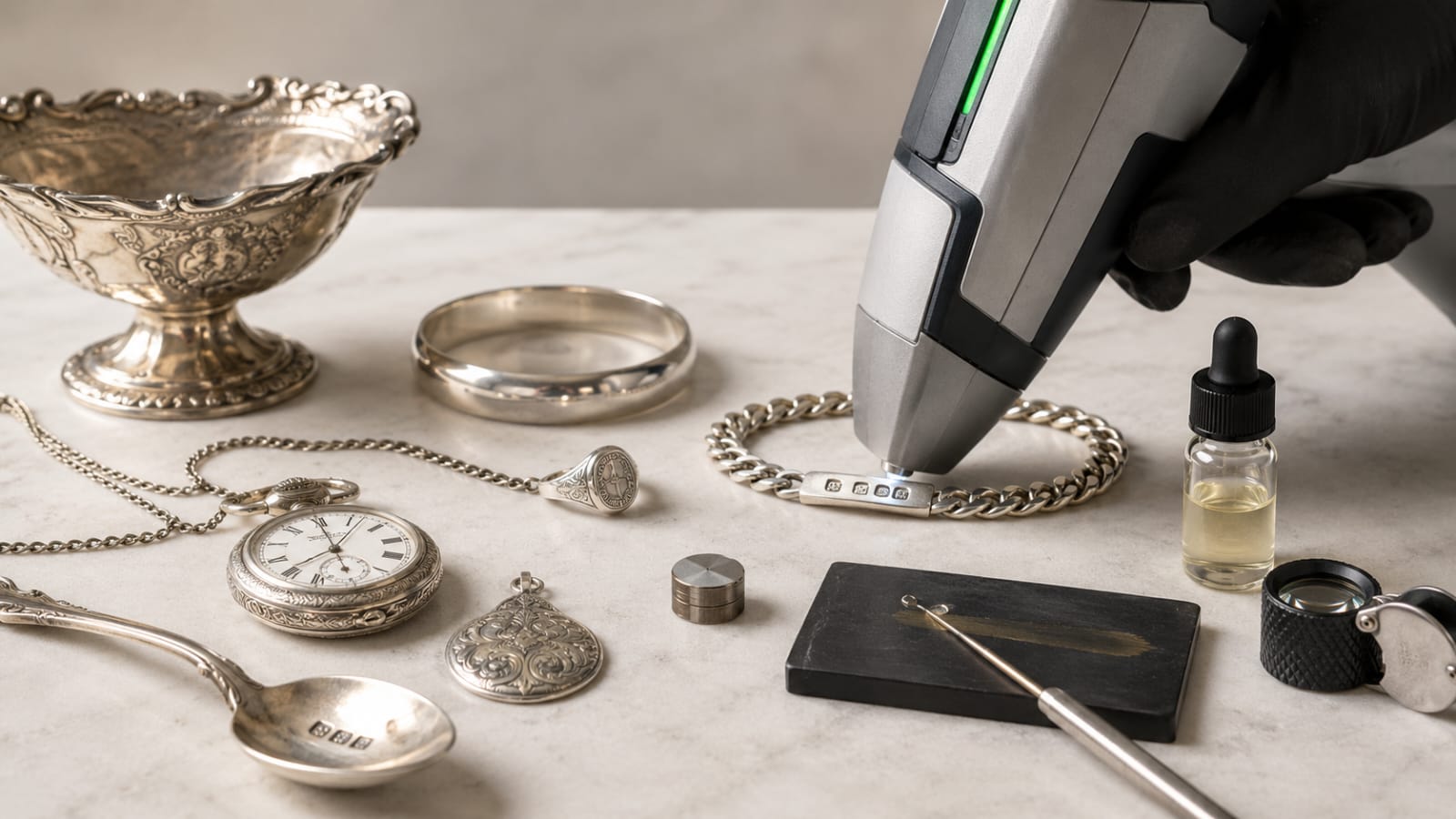
How to Test Silver: Why One Test Is Never the Whole Story
When people talk about how to test silver, there is sometimes an assumption that one quick test can provide a simple yes-or-no answer.
There really isn’t.
A magnet can tell you something. An XRF analyser can tell you a great deal more. Acid testing asks a different question again. Hallmarks, construction, age, provenance and the way an item was manufactured can all provide additional evidence.
The important word there is evidence.
Good precious-metal identification means looking at that evidence together rather than allowing one test result to overrule everything else.
1. The Magnet Test for Silver
The magnet test is one of the quickest silver testing methods available, and it can be extremely useful as an initial screening tool.
Silver itself is not ferromagnetic. Neither is copper, the principal alloying metal in conventional sterling silver.
Therefore, if an object that appears to be solid silver strongly attracts a magnet, that deserves further investigation.
But a magnet does not test silver purity.
Jewellery can contain steel springs, pins, catches, clasp mechanisms and other components. Some components or alloys may contain iron, nickel or other magnetic materials. A magnetic reaction therefore tells you that something magnetic is present; it does not automatically tell you what the entire object is made from.
Equally, an item passing the magnet test proves very little. Copper, brass, aluminium and many other non-precious metals are not strongly magnetic either.
So the sensible interpretation is simple:
Magnetic? Investigate further.
Non-magnetic? Investigate further.
The magnet is a screening tool, not a verdict.
2. XRF Silver Testing
XRF — X-ray fluorescence — is an extraordinarily useful technology for testing silver, gold and other precious metals.
An XRF analyser directs X-rays at an object and measures the characteristic fluorescent X-rays produced by the elements present. The instrument can then identify and estimate the elemental composition of the area being analysed.
That means XRF can provide far more information than a magnet.
Depending on the object and instrument, it may detect elements including silver, copper, gold, zinc and nickel and provide estimated percentages for them.
One of XRF’s greatest advantages is that it can normally obtain this information without damaging the item.
XRF Is a Surface-Sensitive Technique
This is also where one of its important limitations appears.
The depth from which useful XRF information is obtained is not one universal number. It depends on factors including the elements being measured, the material, any coatings, the instrument and the X-ray energies involved.
That matters enormously when testing jewellery.
A plated, coated or surface-enriched object can have a surface composition that is significantly different from the material underneath it. Research involving XRF analysis of historical silver objects and coins has demonstrated that surface composition can differ substantially from the underlying metal.
That does not necessarily mean the XRF machine is wrong.
It means the machine is reporting the material it is able to detect in the area being analysed.
This distinction is important. XRF is excellent technology, but the person operating it still needs to consider plating, coatings, solder, mixed-metal construction and the precise location being tested.
Where possible, several readings from different areas of an object are usually more informative than one isolated measurement.
3. Acid Testing Silver
Acid testing is older, cheaper and considerably less glamorous than XRF, but in knowledgeable hands it remains a useful silver testing method.
This is also where interpretation becomes particularly important.
Different proprietary silver-testing solutions use different chemistry and colour systems, so the manufacturer’s instructions and colour chart for the particular reagent should always be followed.
A traditional reagent known as Schwerter’s solution provides a useful example of why an unexpected colour cannot automatically be translated into the word “fake.”
Published reference charts for this type of test can show reactions ranging from red for high-fineness silver through darker or brown reactions at lower finenesses, with some low-silver alloys producing greenish reactions.
That often surprises people because there is a popular assumption that:
“GREEN = NOT SILVER.”
That is not a universal rule.
Lower-fineness silver contains a greater proportion of alloying metals, and the reagent may react with those metals as well as the silver. Copper, for example, can contribute green or blue-green reactions under certain acid-testing conditions.
A green reaction may therefore be significant, but what it means depends on the reagent, its instructions, the sample being tested and the other evidence presented by the object.
Older and Foreign Silver May Follow Different Standards
When examining antique, vintage or foreign jewellery, it is also important not to assume that every object was manufactured to modern British standards.
Different countries and historical periods have used different silver finenesses. Lower-grade silver alloys have existed historically, particularly in coins and objects produced under other national standards.
Current UK recognised silver fineness standards include 800, 925 sterling, 958 Britannia and 999 fine silver.
An unusual result therefore deserves investigation rather than an immediate conclusion based solely on what a modern British sterling article would normally contain.
The Limitations of Silver Acid Testing
Unlike XRF, acid testing can also be destructive.
Applying acid directly to jewellery can cause staining, etching or permanent damage.
A touchstone test is less invasive because material is rubbed onto the stone before the reagent is applied. However, the tester still needs to obtain a representative sample. With plated objects, testing only surface material can give a misleading impression of what lies underneath.
Acid testing also requires experience. Colours are not always perfectly textbook. Lighting, contamination, reagent age and reagent strength can all affect interpretation, and different commercial testing solutions may use different colour systems.
That is why one unexpected colour should not automatically result in somebody declaring an item “fake.”
Three Silver Tests Ask Three Different Questions
Perhaps the easiest way to understand silver testing is to recognise that these methods are not actually asking the same question.
A magnet asks:
“Is something significantly magnetic present here?”
An XRF analyser asks:
“Which elements can I detect in the area I am analysing?”
An acid test asks:
“How does this exposed sample react to this particular testing reagent?”
Those are three different questions.
Because they are different questions, the results should be considered together rather than treated as competing verdicts.
Don’t Forget Hallmarks and Jewellery Marks
Physical testing should also be considered alongside the marks present on an object.
But there is another important distinction here: a number stamped into jewellery is not necessarily a hallmark.
A full UK hallmark contains prescribed elements providing independent information about the sponsor or maker, precious-metal fineness and the Assay Office responsible for the mark.
A simple 925 or S925 stamp on its own is therefore not the same thing as an independent UK Assay Office hallmark.
That distinction matters because a recognised hallmark carries a different evidential status. Hallmarking exists specifically to provide independent verification of precious-metal fineness.
Our Approach: Build a Body of Evidence
At Alex Ruby, when we examine an uncertain piece, we are interested in the whole picture.
What is the item marked? Is it actually hallmarked? Who made it? When and where was it manufactured? Is it magnetic? How is it constructed? Does the surface appear plated or coated? What does acid testing suggest? What does XRF suggest, if available? Are results consistent when different areas are tested?
Most importantly, do the different pieces of evidence agree with one another?
If they do not, that does not automatically mean somebody has discovered a fake.
It means you have discovered something that requires more investigation.
If You Need Certainty, Ask the Experts
There comes a point where home testing, reseller testing and even professional workshop testing should give way to independent professional analysis.
That is where the UK’s Assay Offices come in.
The purpose of hallmarking is to provide independent verification of precious-metal fineness, and Assay Offices can offer professional precious-metal testing and analytical services appropriate to the item and circumstances.
So our golden rule is simple:
If the answer genuinely matters and the available evidence does not provide enough confidence, seek independent professional testing.
Sometimes the most knowledgeable thing a tester can say is not:
“I know exactly what this is.”
It is:
“I don’t have enough evidence yet.”
And in precious-metal testing, that distinction matters.
Because testing is not about proving yourself right.
It is about finding out what the object actually is.
This article is general educational information about jewellery and precious-metal testing and is not a substitute for professional assay or legal advice. Test results can be affected by an item’s construction, coatings, plating, alloy, condition and the testing methodology used.