
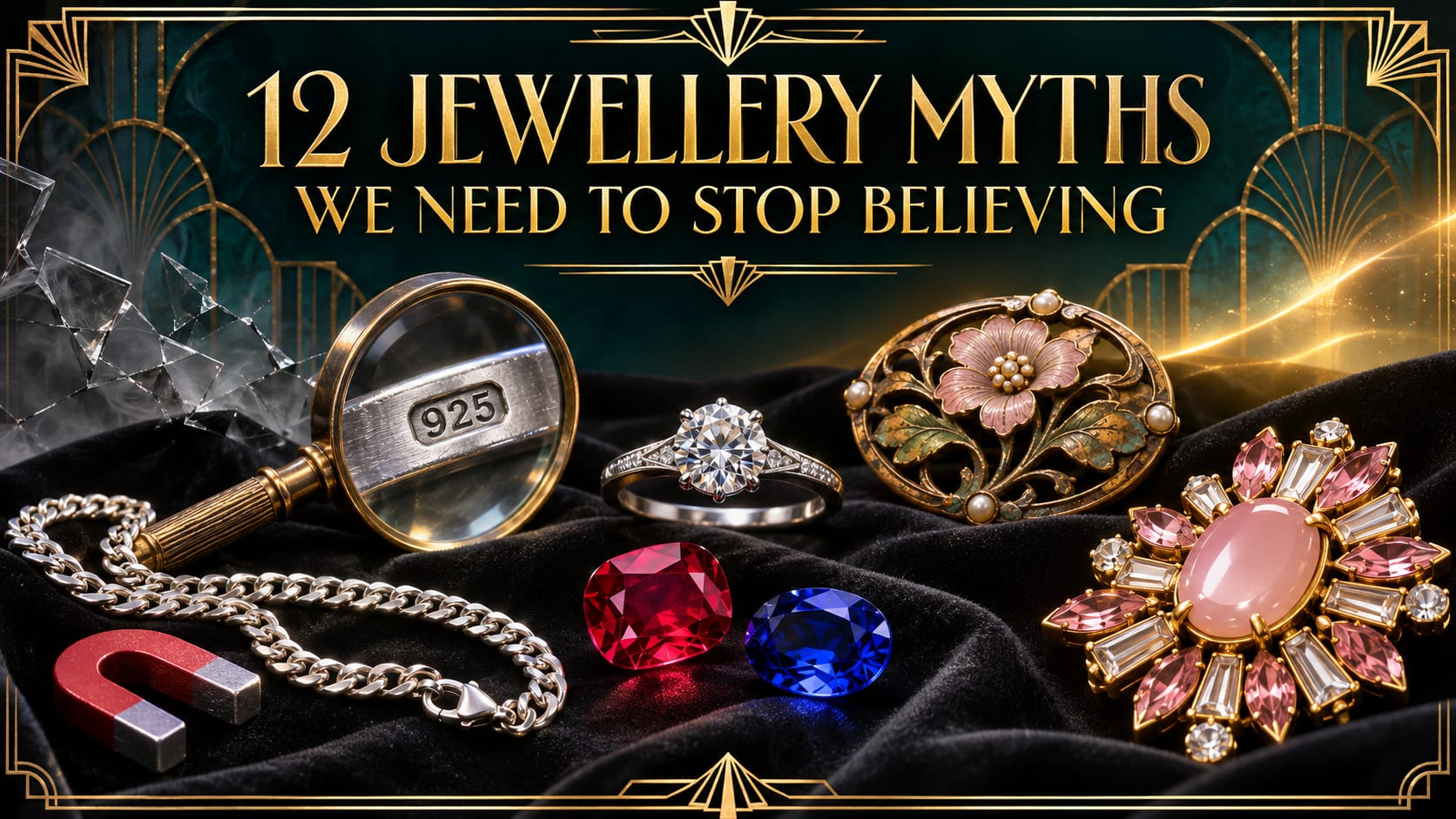
12 Jewellery Myths We Need to Stop Believing
Jewellery is surrounded by myths, half-truths and advice passed down through generations.
Some of it is useful. Some of it is harmless. And some of it can lead to beautiful jewellery being misidentified, damaged, undervalued or thrown away.
At Alex Ruby Trading Co., we believe that understanding jewellery should be enjoyable and accessible. You should not need a gemmology qualification to ask sensible questions, and you should never be made to feel foolish for not already knowing the answers.
From magnets and 925 stamps to green fingers, enormous gemstones and overenthusiastic polishing, here are 12 jewellery myths we really need to stop believing.
Myth 1: If It Sticks to a Magnet, It Cannot Be Silver
This is one of the most repeated jewellery myths — and it contains just enough truth to be misleading.
Silver itself is not strongly magnetic. Therefore, if the main body of an item is strongly attracted to a magnet, that may suggest the presence of iron, steel or another magnetic metal.
However, that does not automatically mean the entire piece is fake.
A genuine silver necklace or bracelet may contain a small steel spring inside its clasp. Brooch mechanisms, earring fittings and replacement components may also react to a magnet even when the main piece is silver.
The opposite is equally important: an item not sticking to a magnet does not prove that it is silver. Copper, brass, aluminium and many other base metals are also non-magnetic.
The Truth
A magnet is a useful screening tool, but it is only one part of the testing process. The location and strength of the reaction matter, and no responsible identification should rely on a magnet alone.
Myth 2: A 925 Stamp Guarantees Sterling Silver
The number 925 means that an item is being represented as containing 925 parts silver per thousand — the standard traditionally known as sterling silver.
Unfortunately, anybody with access to a metal stamp can apply the number 925 to an object.
A simple 925 stamp is not necessarily the same as a complete, independently applied UK hallmark.
For articles above the relevant legal exemption weight, a UK hallmark normally includes compulsory elements identifying the sponsor or importer, the metal’s fineness and the assay office responsible for testing it.
Small items below the statutory exemption weight may legally be sold without a full UK hallmark. Imported, older and internationally marked pieces can also require additional knowledge to interpret correctly.
This means an item without a full UK hallmark is not automatically fake — but neither should a lone 925 stamp be treated as unquestionable proof.
The Truth
A 925 stamp is useful information, not a guarantee. Testing, construction, provenance and the complete set of marks must all be considered.
Myth 3: If Jewellery Turns Your Skin Green, It Must Be Fake
Green skin usually results from a chemical reaction between moisture, acids or products on the skin and copper contained in the jewellery.
Copper is common in base-metal jewellery, but jewellers also use it in precious-metal alloys because pure gold and silver can be too soft for many practical purposes.
Consequently, even an item containing genuine silver or gold may occasionally leave temporary discolouration, particularly in hot weather or after contact with sweat, hand cream, perfume or cleaning products.
The reaction may also vary from one person to another. Jewellery that marks one wearer may cause no reaction at all on somebody else.
Skin discolouration should not be confused with an allergic reaction. Itching, swelling, blistering or persistent irritation should be taken seriously, and the wearer should remove the item.
The Truth
A green mark does not, by itself, establish whether jewellery is genuine or fake. It tells us that a chemical reaction has occurred, not the complete composition or value of the piece.
Myth 4: Heavy Jewellery Is Automatically Valuable
Weight can matter when jewellery contains precious metal, but heaviness alone tells us very little.
A substantial piece may contain inexpensive base metal, glass, resin or heavily plated material. Conversely, a valuable piece may be delicate, hollow or expertly constructed to use very little metal.
Weight must always be considered alongside:
- Metal content.
- Hallmarks and testing.
- Gemstone quality.
- Construction.
- Craftsmanship.
- Age and condition.
- Designer or maker.
- Rarity and desirability.
- Provenance.
An enormous base-metal necklace may weigh more than a fine antique gold pendant without approaching its financial value.
That does not make the necklace worthless. Its value may simply come from its design, maker or collectability rather than its metal content.
The Truth
Heavy does not automatically mean valuable, and lightweight does not mean cheap.
Myth 5: Diamonds Are Impossible to Damage
Diamond is the hardest naturally occurring material, but hardness is not the same as toughness.
Hardness describes resistance to scratching. Toughness describes resistance to breaking, chipping or fracturing.
A diamond can withstand a great deal of wear, but a sharp impact in the wrong place can still chip it. Corners, points, thin girdles and areas affected by certain inclusions may be particularly vulnerable.
The setting can also suffer damage. A perfectly intact diamond can be lost if a worn or bent claw no longer holds it securely.
Intense heat during jewellery repairs can also affect diamonds. Fracture-filled or otherwise treated diamonds may require additional care because certain cleaning and repair methods can damage the treatment.
The Truth
Diamonds are exceptionally hard, not indestructible. Remove diamond jewellery for heavy work, sport and activities involving hard knocks, and have important settings checked periodically.
Myth 6: All Antique Jewellery Should Be Polished Until It Shines
A little dirt and decades of patina are not the same thing.
Careful cleaning may reveal the beauty of an older piece, but aggressive polishing can remove plating, original surface finishes, oxidised detail and evidence of age.
On some jewellery, craftspeople deliberately created darker areas to emphasise engraving or decoration. On others, the patina developed gradually and became part of the piece’s character.
Overpolishing can soften crisp details, erase delicate marks and permanently alter the appearance of a historic object.
Plated jewellery needs particular caution because polishing can wear through the thin surface layer and expose the base metal underneath.
Gemstones also respond differently to cleaning. A method that is safe for diamond may harm pearl, opal, turquoise, coral, amber or a treated stone.
The Truth
Clean conservatively. If a piece is antique, valuable, plated or set with an unfamiliar gemstone, seek appropriate advice before using dips, abrasives, ultrasonic machines or chemical cleaners.
Myth 7: Costume Jewellery Has No Value
Costume jewellery may not contain precious metals or natural gemstones, but material value is only one form of value.
Collectors may seek costume jewellery because of its:
- Designer or maker.
- Quality of construction.
- Rarity.
- Age.
- Condition.
- Cultural importance.
- Unusual design.
- Celebrity or fashion connections.
- Original packaging.
- Place within jewellery history.
Signed pieces by collectable makers can command considerable prices, but unsigned jewellery may also be desirable when the craftsmanship and design are exceptional.
Some vintage costume jewellery features intricate stone settings, hand-finished components, specialist glass and techniques that are costly or uncommon today.
The Truth
Costume jewellery is not failed fine jewellery. It is a collecting field in its own right, with its own history, artistry and market.
Myth 8: A Bigger Gemstone Is Always More Valuable
Size is only one factor in gemstone valuation.
A large gemstone may be heavily included, poorly cut, treated, synthetic, composite or made from a relatively abundant material. A smaller stone with exceptional colour, clarity, cut, origin or rarity may be significantly more valuable.
For diamonds, carat measures weight rather than visible size. Two diamonds of identical carat weight can look different in size depending on their proportions and cut.
Coloured gemstones require an even broader assessment. Important factors can include:
- Colour and saturation.
- Clarity and transparency.
- Cut and proportions.
- Carat weight.
- Natural or laboratory-grown origin.
- Treatments and enhancements.
- Geographic origin, when reliably established.
- Rarity.
- Certification.
- Current market demand.
The Truth
Bigger may be more dramatic, but it does not automatically mean better, rarer or more valuable.
Myth 9: A Hallmark Tells You Everything About a Piece
A genuine hallmark can provide extremely useful information about precious-metal fineness, the assay office and the registered sponsor or importer.
However, it does not usually tell you:
- The identity of every craftsperson involved.
- The gemstone species or quality.
- Whether a stone is natural, treated or laboratory-grown.
- The retail value.
- The age of every component.
- Whether the item has undergone repairs or alterations.
- Whether the sponsor physically made the piece.
- The item’s full ownership history.
Date letters can help with dating when present, but they are not compulsory on modern UK hallmarks. Imported pieces and jewellery assembled from older components can also complicate the story.
The Truth
A hallmark is valuable evidence, but it is not a complete biography of the jewellery.
Myth 10: Vintage, Antique and Retro All Mean the Same Thing
These words are often mixed together in online listings, but they are not perfect synonyms.
Antique jewellery is generally understood to be at least 100 years old.
Vintage is a broader and less legally precise term. It normally describes an older piece associated with a recognisable period or style, but it does not automatically mean antique.
Retro can refer specifically to jewellery influenced by the bold designs of the 1930s and 1940s, although people also use the word more loosely for later pieces inspired by a previous era.
Vintage-style, antique-style and reproduction are different again. These describe the appearance of an item rather than proving its age.
The Truth
A newly manufactured Victorian-style brooch may be beautiful, but it is not a Victorian brooch. Age should be supported by construction, materials, marks, documented history and expert assessment rather than appearance alone.
Myth 11: Every Blue Stone Is Sapphire and Every Red Stone Is Ruby
Colour is not enough to identify a gemstone.
A blue stone could be sapphire, spinel, topaz, zircon, tourmaline, glass, synthetic material, dyed quartz or one of many other possibilities.
A red stone might be ruby, garnet, spinel, tourmaline, glass, a laboratory-grown material or a composite stone.
Even experienced jewellery dealers cannot reliably identify every gemstone from a photograph. Lighting, camera settings and surrounding metal can change the appearance of colour dramatically.
Basic gemstone testers can be helpful, but their readings may overlap between different materials. They should be used alongside magnification, observation and other appropriate tests.
Describing an uncertain stone as “ruby” or “sapphire” simply because of its colour can create an inaccurate and potentially misleading listing.
The Truth
Colour provides a clue, not a conclusive identification. When a professional has not identified a stone, cautious wording is the honest approach.
Myth 12: If Jewellery Is Unsigned, It Cannot Be Collectable
Many wonderful pieces of jewellery were never signed.
Marks can be absent because:
- The original maker did not sign the piece.
- The item predates widespread brand marking.
- The maker placed a mark on a removable component.
- Someone later replaced a clasp or fitting.
- Wear has made the mark difficult to read.
- The workshop produced the piece for another retailer.
- Researchers have not yet identified the maker or workshop.
A signature can add interest and value, but it should never replace an assessment of the complete object.
Design, construction, materials, condition, rarity and documented provenance may all make an unsigned piece collectable.
Attributions still require caution. Looking similar to a famous designer’s work does not prove that the designer made it.
The Truth
Unsigned does not mean unimportant. Some jewellery mysteries remain unsolved, and that can be part of their charm.
Why Jewellery Myths Survive
Most jewellery myths begin with a small piece of truth.
Magnets can help identify suspicious metal. Stamps can provide information. Weight can affect precious-metal value. Large gemstones can be rare. Diamonds are extremely hard.
Problems arise when a useful clue becomes an absolute rule.
Jewellery identification works more like a puzzle. Marks, materials, construction, testing, condition, history and design all contribute pieces of information. One clue rarely provides the entire answer.
That is why responsible sellers sometimes say:
- “Tests as…”
- “Believed to date from…”
- “In the style of…”
- “Stone unidentified.”
- “Likely antique or vintage; provenance unknown.”
- “Stamped 925 but not independently verified.”
Careful wording is not evasive. It is honest.
The Alex Ruby Approach
At Alex Ruby Trading Co., our values are education, transparency, traceable sourcing and jewellery without snobbery.
We believe customers deserve to know what has been tested, what can be verified and what remains uncertain.
We also believe that jewellery does not need to contain precious metal or carry a famous signature to be worth loving.
A piece can be valuable because of its materials. It can also be valuable because it is beautifully designed, historically interesting, skilfully made, wonderfully eccentric or simply perfect for the person wearing it.
The most important thing is to separate evidence from assumption — and fact from jewellery folklore.
Final Thoughts
Jewellery is far more interesting when we stop forcing it into simple categories of real or fake, precious or worthless, old or new.
A magnet cannot tell the whole story.
A stamp cannot tell the whole story.
A gemstone’s colour, size or weight cannot tell the whole story.
Every piece deserves consideration as a complete object, with its materials, craftsmanship, condition and history examined together.
So ask questions. Look closely. Test responsibly. Learn as you go.
And never dismiss a fabulous piece of jewellery simply because somebody repeated a myth about it.
TL;DR? 12 Jewellery Myths in Brief
A magnet is not a complete silver test, a 925 stamp is not an automatic guarantee, green skin does not always mean fake and diamonds are not indestructible.
Bigger and heavier do not automatically mean more valuable. Costume jewellery can be highly collectable, unsigned pieces can still be important and aggressive polishing can permanently damage antique or plated jewellery.
In short: one clue never tells the whole story.
Buy what you love, ask sensible questions and choose sellers who are honest about what they know — and what they do not.
Discover jewellery with character at Alex Ruby Trading Co.