
Pearls Fit for a Princess: Why Royalty Continues to Choose the World’s Most Timeless Gem
From royal heirlooms to modern jewellery collections, pearls remain enduring symbols of elegance, heritage and understated luxury.
Few gemstones possess the quiet authority of a pearl.
Diamonds may command attention with their brilliance, while coloured gemstones captivate with their intensity. Pearls offer something altogether different: softness, sophistication and a natural glow that has enchanted royalty and jewellery lovers for centuries.
For jewellers, pearls are particularly fascinating. They are organic, individual and wonderfully varied, with every pearl possessing its own character.
Their appeal extends far beyond fashion. Pearls connect generations through jewellery that is treasured, gifted, inherited and worn again.
Once again, the royal spotlight has reminded us why royalty chooses pearls.
Kate Middleton’s Pearl Tiara Moment at Windsor Castle
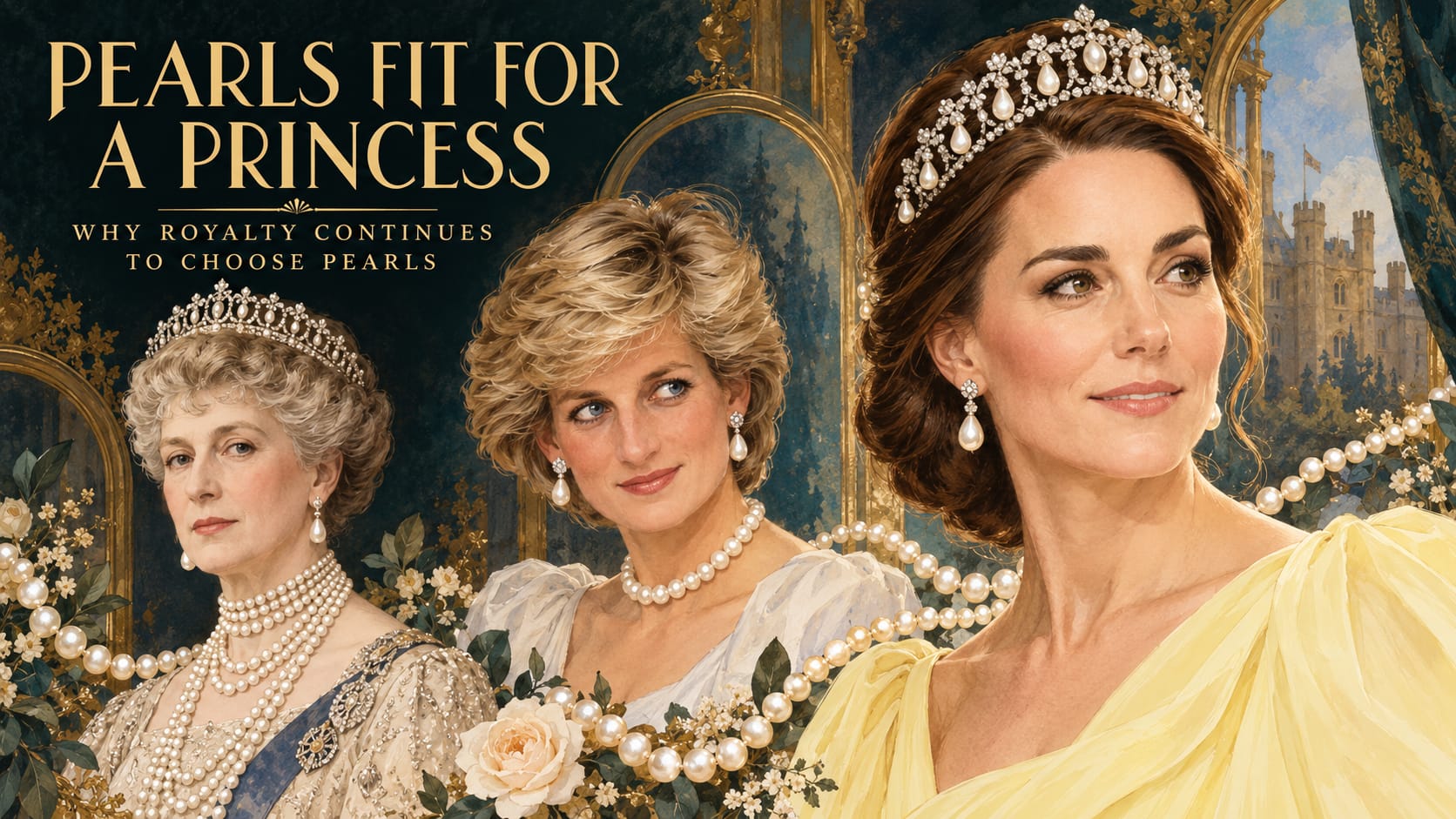
During the state banquet at Windsor Castle on 20 October 2026, held in honour of Sultan Haitham bin Tarik of Oman, Catherine, Princess of Wales—widely known as Kate Middleton—wore Queen Mary’s Lover’s Knot Tiara.
The historic tiara features diamond arches with suspended, pear-shaped pearls. It was famously worn by the late Diana, Princess of Wales, and has become one of Catherine’s most recognisable royal jewels.
You can see the Princess of Wales wearing the pearl-and-diamond tiara in British Vogue’s report on the Oman state banquet.
Catherine paired the tiara with a pale yellow Elie Saab gown and other historic royal jewels. Yet despite the brilliance of the diamonds, it was the tiara’s suspended pearls that gave the look its distinctive softness and movement.
The choice was about far more than sparkle.
By wearing an heirloom associated with Queen Mary and Princess Diana, the Princess of Wales connected several generations of royal women through a single piece of jewellery.
This is one reason royalty continues to choose pearls: they communicate elegance while carrying family history, continuity and symbolism.
The Enduring Allure of the Lover’s Knot Tiara
Queen Mary commissioned the Lover’s Knot Tiara from Garrard in 1913. Its design was inspired by an earlier tiara belonging to her grandmother, Princess Augusta of Hesse-Kassel, Duchess of Cambridge.
The design combines a diamond framework with a series of suspended pear-shaped pearls.
Its structure is formal and architectural, but the moving pearls prevent it from appearing rigid. They soften the brilliance of the diamonds and create graceful movement whenever the wearer turns her head.
From a jeweller’s perspective, this is an exceptional example of thoughtful design.
The pearls do not compete with the diamonds. They enhance them.
Diamonds reflect light with sharp brilliance, while pearls return it as a softer, more diffused glow. Together, they produce contrast, depth and movement.
It is a reminder that the finest jewellery is rarely about simply wearing the largest or most expensive stones. It is about proportion, craftsmanship and the way individual materials work together.
Why Does Royalty Keep Choosing Pearls?
Pearls have remained part of royal jewellery collections for several interconnected reasons.
Pearls represent continuity
Royal jewellery is often passed between generations. Pearls lend themselves particularly well to this tradition because they rarely look tied to one particular fashion period.
A pearl necklace, brooch or pair of earrings can be worn by several generations without losing its relevance.
Pearls soften formal regalia
Tiaras, ceremonial orders and important diamond jewellery can appear extremely formal. Pearls introduce softness and movement, making grand jewels appear more graceful and wearable.
Pearls carry historical significance
Before cultured pearl farming made pearls more widely available, fine natural pearls were extraordinarily rare.
Large, well-matched natural pearls were mainly available to royalty, aristocracy and the exceptionally wealthy. Historic pearl jewels therefore became visible signs of status and power.
Pearls photograph beautifully
A fine pearl does not flash like a diamond. Instead, it reflects a soft glow that flatters the skin and remains elegant under different lighting conditions.
This makes pearl jewellery particularly effective at formal daytime and evening events.
Pearls do not need to shout
Royal dressing often requires jewellery that communicates authority without appearing excessively ostentatious.
Pearls achieve this balance beautifully. They can be grand without being brash and luxurious without being overwhelming.
Why Pearls Have Always Belonged to Royalty
Pearls have been prized for thousands of years.
Before cultured pearls became widely available, natural pearls were exceptionally difficult to find. Countless molluscs might be opened before a single attractive pearl was discovered.
Finding enough natural pearls of similar size, colour, shape and lustre to create a matching necklace could take many years.
Their rarity made fine natural pearls some of the most coveted treasures in the jewellery world.
Pearls adorned crowns, necklaces, earrings, brooches and ceremonial pieces. They became associated with refinement, wealth, purity and status.
However, their appeal has never depended on rarity alone.
A pearl necklace worn by one generation can look just as beautiful decades later, whether paired with a formal gown, a tailored jacket or a simple contemporary outfit.
Royal jewellery collections demonstrate this beautifully. Historic pieces are not merely museum objects. They continue to be worn, allowing their stories to evolve while preserving their original significance.
The Lover’s Knot Tiara is a particularly striking example. Its associations with Queen Mary, Princess Diana and Catherine give it remarkable emotional and historical depth.
Its pearls connect different eras of royal style.
For collectors, this continuity is part of the magic of jewellery.
A Jeweller’s Guide to Understanding Pearls
Not all pearls are the same. Understanding their differences can transform the way we appreciate and value them.
Natural Pearls
Natural pearls form without deliberate human intervention.
When an irritant or organism enters a mollusc, the animal may surround it with layers of nacre. Over time, these layers can form a pearl.
Fine natural pearls are rare, and important examples can be highly sought after by collectors.
Their value depends on factors including:
- Size.
- Lustre.
- Shape.
- Surface quality.
- Colour.
- Condition.
- Provenance.
- Whether several pearls form a well-matched group.
Because natural pearls can be extremely valuable, a laboratory report may be necessary to distinguish them from cultured pearls.
Cultured Pearls
Cultured pearls form through human-assisted cultivation within a living mollusc.
A technician introduces a nucleus or piece of mantle tissue, encouraging the mollusc to produce a pearl.
Cultured pearls are genuine pearls. They are not artificial or imitation products.
Most pearls sold in modern jewellery are cultured, and high-quality cultured pearls can possess exceptional beauty, lustre and value.
Akoya Pearls
Akoya cultured pearls are particularly associated with classic pearl necklaces and earrings.
They are celebrated for their:
- Bright, mirror-like lustre.
- Predominantly round shape.
- White or cream body colour.
- Delicate pink, silver or green overtones.
Akoya pearls are an excellent choice for someone seeking traditional elegance and the familiar appearance of a beautifully matched pearl strand.
South Sea Pearls
South Sea cultured pearls are admired for their impressive size and rich, satin-like lustre.
They are produced by large saltwater oysters and occur naturally in shades including:
- White.
- Silver.
- Cream.
- Golden.
Fine South Sea pearls can make a sophisticated statement without elaborate settings. Their size and soft glow allow the pearls themselves to become the centre of the design.
Tahitian Pearls
Often described as black pearls, Tahitian cultured pearls display a much broader range of natural colours.
These may include:
- Grey.
- Charcoal.
- Silver.
- Green.
- Peacock.
- Blue.
- Aubergine.
Their darker body colours and colourful overtones make Tahitian pearls especially appealing to people who want something more distinctive than a traditional white strand.
Not every dark pearl is a Tahitian pearl, and some inexpensive pearls are dyed. Accurate descriptions remain essential.
Freshwater Pearls
Freshwater cultured pearls offer tremendous variety.
They may be round, oval, button-shaped, drop-shaped or wonderfully baroque. Their colours can include white, cream, peach, pink and lavender.
Freshwater pearls make beautiful jewellery available across a wide range of prices.
Fine round freshwater pearls can be impressively lustrous, while baroque examples offer individuality and sculptural character.
Each type of pearl has its own appeal. The right choice depends on personal taste, budget, the intended jewellery design and the qualities that matter most to the wearer.
What Makes a Pearl Truly Beautiful?
One common misconception is that size alone determines a pearl’s value.
In reality, a knowledgeable jeweller considers several factors together.
Lustre
Lustre is one of the most important pearl value factors.
It describes the quality and intensity of light reflected from the pearl’s surface and from within its layers of nacre.
A fine pearl can appear to glow from within. Reflections may look bright, sharp and lively rather than dull or chalky.
Even a large pearl may have limited appeal if its lustre is poor.
Surface Quality
Pearls are organic gems, so minor irregularities are common.
Surface characteristics may include:
- Small pits.
- Wrinkles.
- Ridges.
- Spots.
- Uneven areas.
A cleaner surface generally increases desirability. However, surface characteristics should be considered alongside lustre, size, shape and pearl type.
In baroque pearls, irregularities can be part of the design rather than something that needs to be hidden.
Shape
Perfectly round pearls have traditionally been highly prized, particularly when creating matched necklaces.
However, pearls can occur in many beautiful shapes:
- Round.
- Near-round.
- Oval.
- Button.
- Drop.
- Circled.
- Baroque.
Baroque pearls can be every bit as captivating as round examples. Their unusual contours ensure that no two pieces of jewellery look exactly alike.
Colour and Overtone
Pearl colour includes both the main body colour and any subtle overtone visible across the surface.
Pearls may appear:
- White.
- Cream.
- Silver.
- Pink.
- Peach.
- Golden.
- Grey.
- Green.
- Blue.
- Purple.
There is no universally best pearl colour. Desirability depends on pearl type, rarity, fashion, skin tone and personal preference.
Nacre Quality
Nacre is the material secreted by the mollusc to form the pearl.
Good nacre quality contributes to lustre, beauty and durability. Thin or poor-quality nacre may result in a dull appearance or visible problems around the pearl’s nucleus.
Size
Larger pearls are generally more difficult to produce, particularly when all other quality factors are equal.
However, size should never be judged in isolation.
A smaller pearl with exceptional lustre may be far more beautiful and valuable than a larger pearl with a dull surface.
Matching
Matching is crucial when pearls are used in pairs, necklaces or coordinated jewellery sets.
A jeweller may consider:
- Size.
- Shape.
- Colour.
- Overtone.
- Lustre.
- Surface appearance.
Finding enough pearls that work beautifully together requires skill, patience and a large selection of material.
This is one reason why an exceptionally well-matched pearl necklace can command a substantial premium.
Pearls and Diamonds: A Partnership Made for the Ages
The Lover’s Knot Tiara demonstrates an important jewellery principle: pearls and diamonds can be extraordinary partners.
Diamonds reflect light with sharp brilliance, while pearls offer a softer glow.
The contrast creates depth and visual interest. In the right design, diamonds provide structure and sparkle, while pearls introduce warmth, movement and romance.
This combination is not restricted to tiaras.
It works beautifully in:
- Vintage drop earrings.
- Edwardian-inspired pendants.
- Diamond-set pearl rings.
- Pearl and diamond brooches.
- Bridal jewellery.
- Contemporary asymmetrical designs.
For people who appreciate antique and vintage jewellery, this pairing is especially appealing.
Older pieces often reveal a different approach to design, with greater emphasis on intricate settings, graceful lines and the relationship between materials.
A vintage pearl and diamond jewel can offer something beyond its individual components: a glimpse into the artistic tastes and craftsmanship of its period.
The Importance of Provenance and History
Jewellery is rarely valued on materials alone.
A piece may be treasured because of its age, maker, rarity, design or former owner. Provenance can add another dimension, particularly when an item is documented as belonging to a notable person or forming part of an important collection.
Royal jewellery illustrates this perfectly.
The Lover’s Knot Tiara is fascinating not only because of its diamonds and pearls, but because of the women who have worn it and the history it represents.
For antique jewellery enthusiasts, the same principle applies on a more personal scale.
A pearl brooch passed down from a grandmother may have modest material value compared with a royal jewel, yet its emotional importance can be immeasurable.
This is why jewellery deserves to be appreciated as more than metal and gemstones.
It is craftsmanship, changing fashion and family history captured in a form small enough to wear.
Are Pearls Still Relevant in Modern Jewellery?
Absolutely.
In fact, versatility is one of their greatest strengths.
The traditional single-strand necklace remains an enduring classic, but contemporary designers have reimagined pearls in countless ways.
Baroque pearls are paired with sculptural gold settings. Delicate pearl drops are combined with modern diamonds. Pearls appear on mismatched earrings, bold chains and unconventional rings.
Pearls can be:
- Understated or dramatic.
- Traditional or contemporary.
- Perfectly matched or deliberately irregular.
- Formal or relaxed.
- Minimalist or richly decorated.
They can complement an evening gown, add refinement to everyday clothing or become the centrepiece of a distinctive jewellery collection.
The royal example is particularly instructive.
A historic pearl-set tiara can be worn with a contemporary couture gown and still feel completely relevant. The jewellery brings heritage and meaning to the outfit, while the modern clothing prevents it from feeling confined to the past.
That is the hallmark of truly timeless design.
Caring for Pearl Jewellery
Pearls are more delicate than many mineral gemstones and should be treated thoughtfully.
Their surfaces can be damaged by acids, chemicals, cosmetics and abrasion.
To help protect pearl jewellery:
- Apply perfume, hairspray and cosmetics before putting pearls on.
- Wipe pearls gently with a soft cloth after wearing them.
- Avoid ultrasonic and steam cleaners.
- Do not soak pearl necklaces unnecessarily.
- Store pearls separately from harder gemstones.
- Avoid allowing pearls to become excessively dry.
- Have frequently worn pearl necklaces checked and restrung when necessary.
Traditional advice says pearls should be “the last thing on and the first thing off”.
That remains an excellent rule.
Pearl necklaces are often strung with knots between the pearls. Knotting helps prevent the pearls from rubbing against each other and reduces the risk of losing an entire strand if the thread breaks.
Buying Pearls: Advice From a Jeweller
If you are considering investing in pearl jewellery, look beyond the label and take time to appreciate the pearls themselves.
Examine their lustre in natural light.
Consider whether you prefer the symmetry of round pearls or the individuality of baroque examples. Look closely at the setting, clasp and overall construction, particularly when buying antique or vintage jewellery.
Useful questions include:
- Are the pearls natural or cultured?
- What type of cultured pearls are they?
- Have they been dyed, bleached or otherwise treated?
- Are the colours natural?
- Are the pearls well matched?
- Is the clasp secure?
- Does the thread show signs of wear?
- Are there chips or peeling around the drill holes?
- Is there reliable evidence for claims of rarity or provenance?
If a seller describes pearls as natural, ask for supporting evidence where appropriate—particularly if the price reflects exceptional rarity.
For older jewellery, consider the condition of the piece as a whole. Worn settings, damaged pearls or previous repairs may affect both wearability and value.
Above all, buy something you genuinely love.
The most rewarding jewellery purchases combine quality and character with a design you will enjoy wearing for years.
Looking for the Perfect Pearls?
Paul is our resident pearl man at Alex Ruby Trading Co. and has a particular eye for matching customers with beautiful pearl jewellery.
Whether you are looking for an affordable first strand, characterful baroque pearls, elegant pearl earrings, a vintage piece or something especially luxurious, we have pearl jewellery available for virtually every style and budget.
For pearl enquiries, advice or help finding the right piece, please contact Paul directly at sales@alexruby.co.uk.
Tell him what you are looking for, your preferred style and approximate budget, and he will be delighted to help you explore the available options.
Why Royalty Chooses Pearls: The Final Word
The Princess of Wales’s choice of Queen Mary’s Lover’s Knot Tiara is a beautiful reminder of why pearls have retained their place in royal and fine jewellery.
Their appeal lies not in extravagance alone, but in their ability to bring softness, sophistication, movement and meaning to a design.
Pearls communicate heritage without appearing trapped in the past. They complement diamonds without being overshadowed by them. They can signify status while retaining an air of restraint.
For a jeweller, pearls represent the very best of what jewellery can be: natural beauty enhanced by craftsmanship, materials enriched by history and objects that can be cherished long after the occasion for which they were first worn.
Whether displayed in a royal tiara, set into an antique brooch or worn as a simple strand around the neck, pearls possess a quiet confidence that transcends passing trends.
Perhaps that is why they remain such a fitting choice for a princess.
And perhaps it is why, generations from now, we will still be admiring them.
At Alex Ruby Trading Co., we believe that every piece of jewellery has a story to tell.
Pearls remind us that true luxury is not always about the largest stone or the brightest sparkle. Sometimes, it is the beauty, craftsmanship and history that make a piece worth treasuring.