
Georgian and Victorian Mourning Jewellery: Brooches, Hair and Remembrance
Georgian and Victorian mourning jewellery gave people a way to keep the memory of a loved one close. A name and date engraved inside a ring, a lock of hair beneath glass, or a brooch worn with mourning dress could hold a deeply personal meaning.
However, the tradition did not begin with Queen Victoria, and mourning jewellery was never just one style. Its materials and designs changed over time. The story of each piece depends on details such as its construction, inscriptions and history.
Georgian Mourning Jewellery: Memorials in Miniature
The Georgian period, from 1714 to 1830, saw memorial jewellery made in many forms, including rings, brooches, lockets and bracelets. Some pieces were engraved with the name, age or date of the person being remembered. Families might commission several pieces to share with relatives or friends.
Designs often drew on classical imagery: urns, weeping willows, broken columns, graves and mourning figures. Gold and enamel were common in memorial rings, while hair might be preserved beneath glass or worked into a design.
These motifs were familiar symbols, but a keepsake could also carry a more personal image.
Victorian Mourning Jewellery: Hairwork and Social Custom
Mourning became especially visible in Victorian Britain. Queen Victoria’s long period of mourning after Prince Albert’s death in 1861 helped make mourning clothes and objects familiar signs of bereavement. However, people had worn memorial jewellery and exchanged locks of hair long before then.
Victorian mourning customs became more formal, and what someone wore could depend on their relationship to the deceased, the stage of mourning and their means.
Jet, onyx and black enamel suited sombre mourning dress. Whitby jet was particularly prized for its deep black colour, light weight and ability to be carved and polished.
Hairwork in Victorian Jewellery
Hairwork became a distinctive feature of Victorian jewellery. Hair could be arranged beneath glass or woven and plaited into brooches, bracelets, chains and watch fobs. It offered a tangible link to someone who had died.
However, hair was also exchanged between living relatives, friends and sweethearts as a token of affection. Its presence alone cannot prove that a jewel was made for mourning.
The Mourning Brooches in Our Alex Ruby Collection
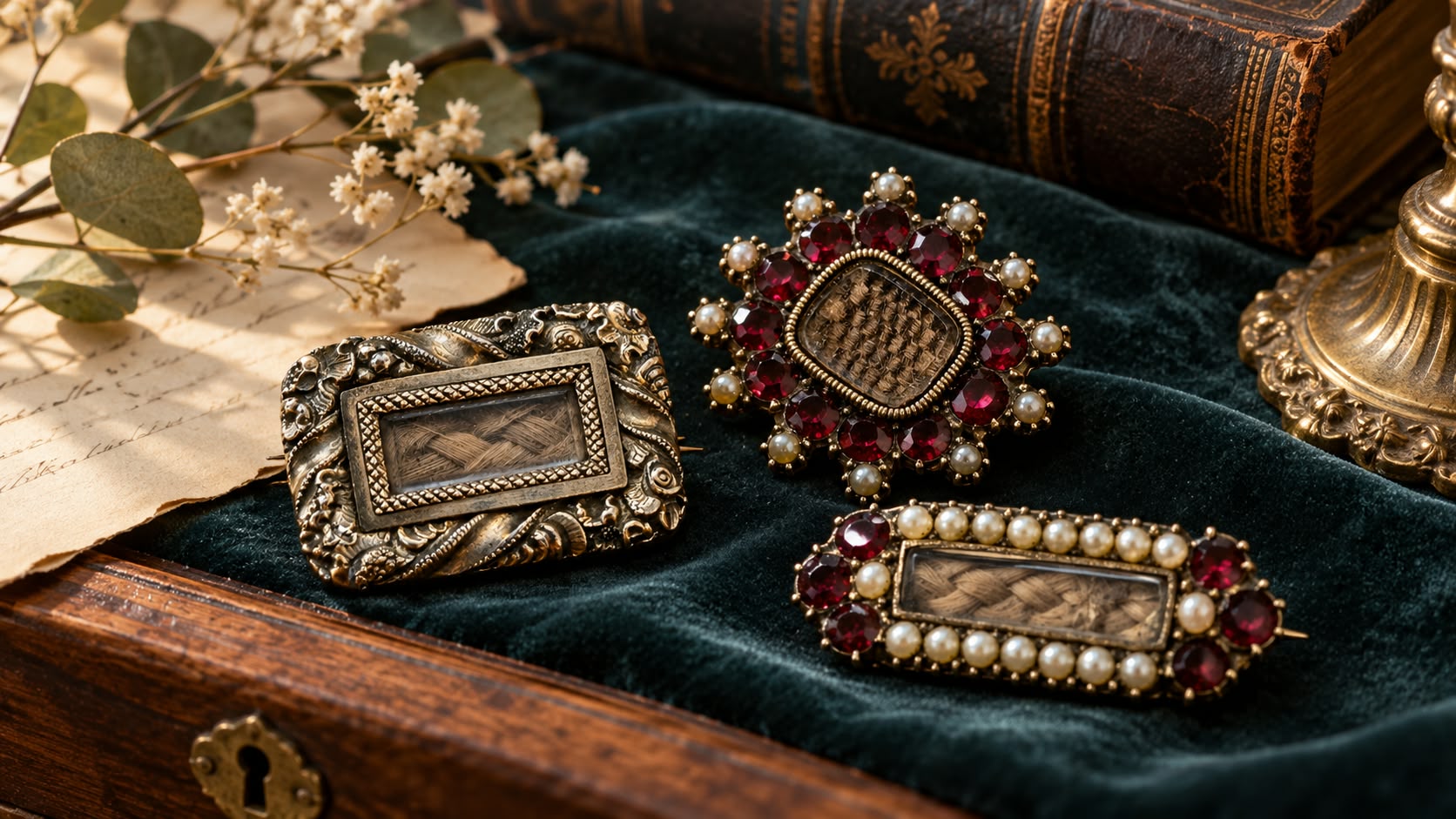
Several of our brooches show hairwork preserved beneath glass. In the photographs, woven hair sits at the centre of ornate settings, with red and pale stones framing some of the panels.
The contrast between the delicate hairwork and decorative settings makes these brooches feel both like jewellery and like keepsakes.
One oval brooch has a scene featuring a stag on the front, with what appears to be preserved hair on the reverse. The stag is more personal than familiar mourning motifs such as the urn or weeping willow.
Without an inscription or provenance, we can’t know what the image meant to its original owner. However, it gives the brooch a distinctive character.
What Can We Tell from the Brooches?
The red stones look garnet-like in the photographs, and the pale stones may be pearls or glass. Those materials would need examination to confirm.
The photographs also can’t establish whether the settings are solid gold, gilt or another metal, or give a reliable date for each brooch.
The visible hairwork makes them compelling memorial or sentimental pieces. Nevertheless, we should be cautious about claiming who the hair belonged to or exactly when the brooches were made.
Materials and Symbolism in Mourning Jewellery
Mourning jewellery could combine precious metals with materials chosen for their colour, texture or associations:
- Jet: Prized for its deep black finish and carving qualities.
- Onyx and black enamel: Dark materials associated with formal mourning.
- Gold and enamel: Often used for memorial rings, inscriptions and decorative details.
- Human hair: Preserved beneath glass or worked into jewellery.
- Pearls: Sometimes interpreted as tears, although meanings varied.
- Urns, willows and broken columns: Images associated with remembrance and loss.
A material or motif can offer clues, but it does not prove a piece’s purpose by itself. Black jewellery could be fashionable, and hair could be a love token.
Inscriptions, construction, period details and provenance all help build a stronger picture.
More Than a Fashion for Black
It is easy to look at mourning jewellery today and see only Victorian formality. For the people who wore it, these pieces could be tender, everyday reminders of someone loved. They gave grief a visible place while carrying a private memory.
From engraved Georgian memorial rings to Victorian hairwork brooches, each piece brings together craftsmanship, social custom and personal feeling.
At Alex Ruby, we love how antique jewellery can hold a story beyond its materials — and how a small brooch can preserve a connection across generations.
How Can You Identify Mourning Jewellery?
A piece should not be described as mourning jewellery solely because it is black, contains hair or looks old.
A memorial inscription, dated engraving, documented provenance or a combination of period features can provide stronger evidence.
If its history is uncertain, “mourning-style” or “possibly memorial jewellery” may be more accurate.