

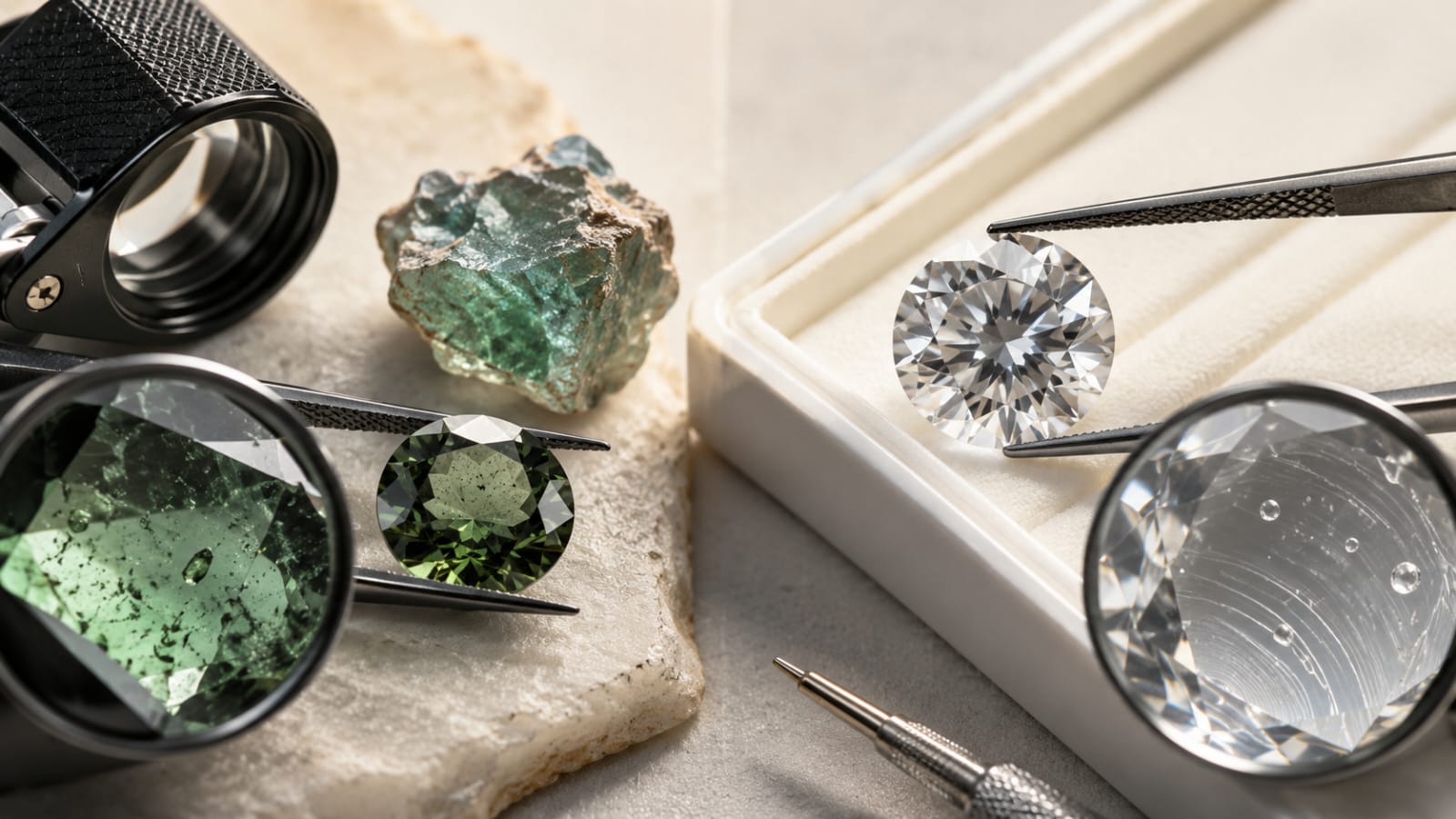
Lab-Created vs Natural Gemstones: What’s the Big Deal Anyway?
If you’ve spent any time buying gemstones, you’ve probably heard the question:
“Is it natural or lab-created?”
Sometimes it is asked as though one answer means “real” and the other means “fake.”
But that is not really how gemology works.
A laboratory-grown ruby is still ruby. A laboratory-grown sapphire is still sapphire. A lab-grown diamond is still diamond. Laboratory-grown gemstones have essentially the same chemical composition, crystal structure and physical properties as their natural counterparts.
The important difference is where and how they formed.
A natural gemstone formed through geological processes in the Earth. A laboratory-grown gemstone was created by people under controlled conditions designed to reproduce the environment needed for that crystal to grow.
So laboratory-grown does not automatically mean fake.
But origin does need to be disclosed, because it can make a substantial difference to rarity, desirability and value.
Natural, Lab-Created, Treated and Simulated Are Different Things
One of the most useful things to understand about gemstones is that origin, treatment and identity are separate questions.
Natural Gemstones
A natural gemstone formed in nature through geological processes.
Simple enough.
Lab-Created or Synthetic Gemstones
A laboratory-grown — or synthetic — gemstone has essentially the same chemical composition and crystal structure as the natural gemstone it reproduces.
Synthetic ruby is ruby.
Synthetic sapphire is sapphire.
Lab-grown diamond is diamond.
What makes these stones different from their natural counterparts is their origin, not their basic gemological identity.
Treated Gemstones
A treated gemstone may be completely natural.
It formed in the Earth and was later altered in some way to improve its appearance, durability or colour.
Heat treatment is one of the most familiar examples. Rubies and sapphires are commonly heated to improve colour or clarity.
So:
Natural + heat-treated = still a natural gemstone.
Treatment and origin are two separate questions.
Gemstone Simulants
A simulant is different again.
A simulant is a material that resembles another gemstone but does not have the same chemical composition and crystal structure.
Cubic zirconia, for example, can simulate the appearance of diamond, but cubic zirconia is not diamond.
That is fundamentally different from a laboratory-grown diamond, which is actually diamond.
How Can You Tell Natural From Lab-Created?
Sometimes you can.
Sometimes you absolutely cannot — at least not with your eyes, a loupe and good intentions.
Gemologists consider a combination of characteristics when determining gemstone origin. One of the most fascinating sources of information is the material found inside the stone:
inclusions.
What Are Gemstone Inclusions?
An inclusion is material enclosed within a gemstone or an internal feature created while the crystal grows or subsequently changes.
Natural gemstones can be miniature geological time capsules.
As a crystal develops underground, it may incorporate tiny mineral crystals, needles, fluids, gases, partially healed fractures, clouds, growth structures and other microscopic material.
These features are not simply “defects.”
To a gemologist, they can be valuable evidence about how a gemstone formed and, in some cases, the geological environment in which it grew.
Do Bubbles Mean a Gemstone Is Synthetic?
This is where things become particularly interesting.
You may have heard the rule:
“If you see bubbles, it’s synthetic.”
That is far too simplistic.
Some synthetic gemstones — particularly certain flame-fusion synthetic rubies and sapphires — can contain small rounded gas bubbles created during the laboratory growth process.
Those bubbles can be a useful clue.
But natural gemstones can also contain fluid inclusions, and those inclusions may contain both liquid and a small gas bubble.
So merely seeing something that looks like a bubble is not enough.
A gemologist wants to know:
What kind of bubble is it? Is it enclosed within a fluid inclusion? What shape is the surrounding feature? Is the bubble isolated? What other inclusions or growth structures are present?
A perfectly round isolated gas bubble accompanied by curved growth lines in a flame-fusion ruby tells a very different story from a small gas bubble suspended inside a natural fluid inclusion.
Context matters.
Common Inclusions in Natural Gemstones
Different gemstones can contain different characteristic inclusions, but several types are particularly useful to learn about.
Rutile Silk
Extremely fine needle-like inclusions are often referred to as silk.
Rutile silk is particularly famous in natural rubies and sapphires. In some stones, intersecting rutile needles can provide useful evidence when assessing origin and treatment.
Included Crystals
A gemstone can literally contain another tiny mineral crystal inside it.
One crystal may become trapped while the larger crystal continues growing around it.
The identity, shape and relationship of these included crystals can sometimes provide valuable gemological information.
Fingerprint Inclusions
Partially healed fractures can create intricate patterns that resemble fingerprints.
These features may contain networks of microscopic cavities, crystals or fluids and can be remarkably beautiful under magnification.
Needles
Long, thin mineral inclusions occur in many gemstones.
Their composition, orientation and appearance can sometimes help gemologists understand the stone’s origin or treatment history.
Fluid Inclusions
Tiny cavities containing liquid, gas or combinations of both can become trapped during natural crystal growth.
And yes — sometimes there really is a tiny bubble inside them.
That is precisely why “bubble = synthetic” is not a reliable universal rule.
What Can Give Away a Lab-Created Gemstone?
That depends heavily on how the synthetic crystal was grown.
There is no single universal “synthetic inclusion.” Different manufacturing processes can leave different microscopic clues.
Flame-Fusion Synthetic Gemstones
Classic flame-fusion synthetic ruby and sapphire may show features such as round gas bubbles, curved growth lines or curved striae and characteristic colour zoning.
Curved growth structures can be particularly useful because natural corundum develops differently.
Flux-Grown Synthetic Gemstones
Flux-grown gemstones may contain remnants of the flux used during crystal growth.
These inclusions can appear wispy, granular, cloudy or web-like.
Some can look surprisingly natural, which is exactly why identifying synthetic material is not always straightforward.
Hydrothermal Synthetic Gemstones
Hydrothermal growth can produce another collection of characteristic growth structures and inclusions.
Modern laboratory-grown gemstones can also be highly sophisticated.
The idea that every synthetic gemstone will be perfectly clean, obviously artificial and easy to identify is outdated.
What Does Heat Treatment Look Like?
Again, there is no single universal answer.
Heat affects different gemstones — and different inclusions — in different ways.
In corundum such as ruby and sapphire, gemologists may look for features including partially dissolved rutile silk, altered mineral inclusions, changes surrounding included crystals, modified fractures and other microscopic evidence consistent with heating.
The important point is that heat treatment does not make a gemstone synthetic.
If a sapphire formed naturally and was subsequently heated, it remains a natural, heat-treated sapphire.
Origin and treatment should therefore be considered separately.
Can You Learn to Examine Gemstones Yourself?
Absolutely.
And this is one of the reasons gemstones become so addictive.
Buy a decent 10× jeweller’s loupe — or start looking through a gemological microscope — and an entirely new world appears inside the stones.
Start learning to recognise needles, crystals, fingerprints, growth zoning, colour zoning, curved growth lines, fractures, fluid inclusions, gas bubbles and silk.
But do not fall into the trap of learning one characteristic and turning it into an absolute rule.
One bubble does not prove synthetic.
One inclusion does not prove natural.
One perfectly clean-looking gemstone does not prove laboratory-grown.
Gem identification works by building a body of evidence.
Sometimes You Simply Cannot Tell
This may be the most important lesson of all.
There are gemstones for which an experienced gemologist can make a confident determination using microscopy and conventional gemological equipment.
There are others for which determining natural versus laboratory-grown origin — or identifying a sophisticated treatment — may require advanced laboratory instrumentation.
Professional gemological laboratories themselves use multiple testing techniques because no single observation answers every question.
So if someone can glance at every gemstone for three seconds and confidently announce:
“Natural.”
“Synthetic.”
“Heat-treated.”
It is reasonable to ask what evidence supports that conclusion.
Good gemology includes knowing when you do not yet have enough information.
Want to Learn More? Go Down the Gemology Rabbit Hole
If this subject interests you, learn more about it.
The Gemological Institute of America — GIA — publishes extensive educational material online, including gemstone information, articles, videos and extraordinary photomicrographs showing natural, synthetic and treated gemstones.
Even studying photographs of known inclusions can be enormously educational.
And if you really catch the bug, formal gemology courses and qualifications are available through recognised gemological institutions.
Because once you start looking inside gemstones, you discover that the subject is considerably more interesting than:
“Is it real or fake?”
The better questions are:
What is it?
How did it form?
Has it been treated?
What does the evidence tell us?
And sometimes the most scientifically accurate answer of all is:
“I need to investigate further.”
This article is general educational information about gemstones and gemology. Visual examination, home testing and basic gemological equipment cannot always establish whether a gemstone is natural, laboratory-grown or treated. Where origin or treatment materially affects value, professional gemological laboratory testing may be appropriate.