

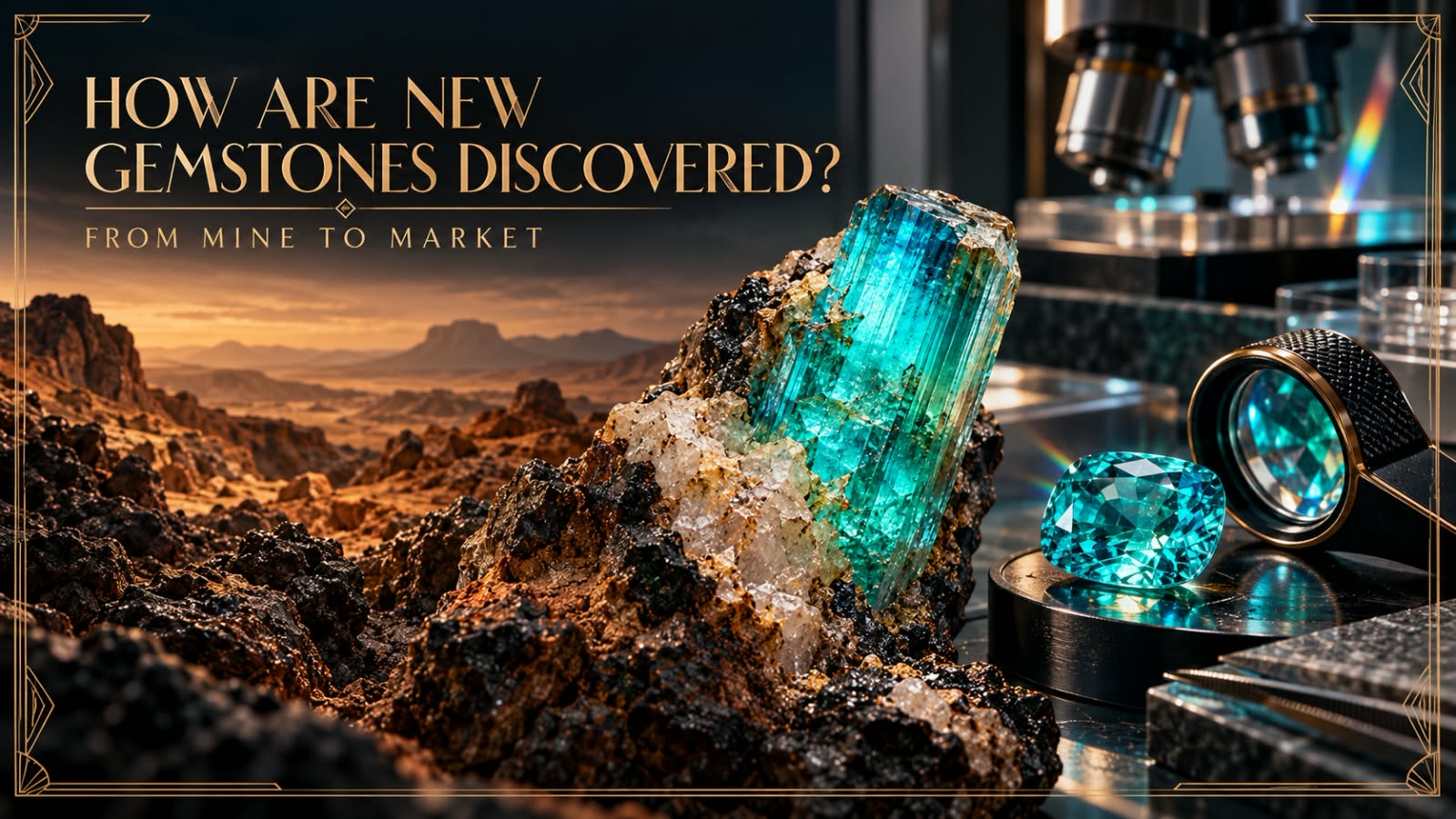
How Are New Gemstones Discovered? From an Unexpected Find to a Recognised Gem
The idea of discovering a new gemstone sounds wonderfully romantic: a flash of extraordinary colour in the soil, an excited miner holding an unfamiliar crystal to the light and, perhaps, an entirely new treasure entering the world of jewellery.
Sometimes, it really does begin like that.
However, finding an unusual stone is only the first step. Before the gem trade can confidently describe, value and sell the material, gemmologists must establish what it is, where it came from, what gives it its colour and whether it has been treated.
The process can take months or years. It may involve miners, local dealers, geologists, gemstone cutters, laboratories, universities and international mineralogical organisations.
A recent example is the newly confirmed Ethiopian source of copper-bearing Paraíba tourmaline. The tourmaline itself is not a newly discovered mineral, but Ethiopia is a significant new source—and its discovery shows how modern gemmological detective work happens.
What Does “New Gemstone” Actually Mean?
The phrase “new gemstone” can describe several very different discoveries.
It might mean:
- A genuinely new mineral species that has never previously been scientifically described.
- A newly recognised gem-quality variety of a known mineral.
- A new source or deposit of a gemstone already known elsewhere.
- A new colour, optical effect or unusual quality within a familiar gemstone.
- A newly introduced trade name for an existing material.
These categories are not interchangeable.
Tanzanite, for example, is not a separate mineral species. It is the blue-to-violet gem variety of zoisite.
Paraíba tourmaline is a copper-bearing variety of tourmaline rather than an entirely separate mineral.
Meanwhile, a new mineral species must possess a sufficiently distinct chemical composition and crystal structure to receive formal scientific approval.
This distinction matters because words such as “new”, “rare” and “discovered” can create excitement—and sometimes inflate prices—before the science has caught up with the marketing.
Stage One: Something Unusual Appears
Many gemstone discoveries begin with people who know the land intimately.
Miners may notice a colour or crystal shape that differs from the material they normally recover. A local trader might see unfamiliar rough in a parcel, while a cutter may notice unexpected optical behaviour when a stone is polished.
Other discoveries are more deliberate. Geologists study rock formations, historical mining records, satellite imagery and the geological conditions in which particular minerals form.
Prospectors then examine promising areas, collect samples and attempt to trace gem-bearing gravel back towards its original rock source.
Some gemstones are found in primary deposits, still embedded in the rock where they formed. Others are recovered from secondary or alluvial deposits after weathering has released the crystals and water has carried them into riverbeds or gravel layers.
At this stage, a remarkable appearance is only a clue.
Colour alone cannot identify a gemstone.
The Ethiopian Paraíba Tourmaline Discovery
In 2026, reports began circulating through the gemstone trade about unusual blue, bluish-green, violet and purple tourmalines coming from southern Ethiopia, reportedly from the Abuloo area of the Guji Zone.
The colours suggested that the stones might be copper-bearing tourmalines of the type widely known as Paraíba tourmaline. Until then, established sources included Brazil, Nigeria and Mozambique.
Yet appearance was not enough.
Many ordinary tourmalines can be blue or green, while photography, lighting and treatment can all alter the way colour appears.
Researchers at the Gemological Institute of America and Gübelin Gem Lab independently examined samples.
Their work confirmed that the Ethiopian material was tourmaline coloured predominantly by copper. It therefore fell within the internationally accepted definition of Paraíba tourmaline.
The laboratories also found chemical characteristics that could help distinguish Ethiopian stones from known material originating in Brazil, Nigeria and Mozambique.
In particular, patterns involving vanadium, gallium and lead contributed to a recognisable Ethiopian chemical signature.
This was not the discovery of a new mineral. It was the scientific confirmation of an important new geographical source of an exceptionally valuable gemstone.
That distinction may sound small, but it has major consequences for identification, disclosure, pricing and laboratory origin reports.
Stage Two: Establishing Provenance
Before researchers can confidently connect a gemstone with a new deposit, they need reliable samples.
Ideally, gemmologists visit the mining area themselves and collect material directly from the ground or from miners working at the source.
Researchers may also examine stones supplied through trusted mining companies or dealers. However, every additional step between the mine and laboratory creates another opportunity for parcels to become mixed.
Good documentation can include:
- The precise mining location.
- Photographs and geological maps of the deposit.
- The date and circumstances of collection.
- Details of the person who recovered or supplied the material.
- Sealed and numbered sample parcels.
- Comparisons between rough crystals, cut stones and surrounding rock.
This chain of custody is vital.
A laboratory may be able to identify a mineral without knowing where it came from. However, establishing geographical origin requires dependable reference material.
Stage Three: Traditional Gemmological Testing
The first laboratory examinations are often conducted using established gemmological instruments.
Tests may include:
- Refractive index, showing how the material bends light.
- Specific gravity, comparing the stone’s weight with the volume of water it displaces.
- Examination with a polariscope or refractometer to study optical behaviour.
- Pleochroism, where different colours appear when the crystal is viewed from different directions.
- Fluorescence under ultraviolet light.
- Microscopic examination of inclusions, fractures and growth structures.
These observations allow gemmologists to place the stone within—or rule it out of—known mineral families.
Microscopic inclusions can be particularly revealing.
Tiny crystals, fluids, gas bubbles and growth features may record the geological environment in which a gemstone formed. In some cases, characteristic inclusions also help separate natural gemstones from laboratory-grown stones or reveal evidence of treatment.
Stage Four: Advanced Scientific Analysis
When a material is unusual, extremely valuable or potentially new, laboratories use more advanced techniques.
Raman spectroscopy can identify a mineral by examining the way its crystal structure scatters laser light.
Infrared spectroscopy can reveal structural features and evidence of substances such as resin, oil or water.
Ultraviolet-visible-near-infrared spectroscopy helps researchers understand which elements and processes create a gemstone’s colour.
Chemical techniques, including X-ray fluorescence and laser ablation inductively coupled plasma mass spectrometry, can detect major, minor and trace elements.
The concentrations and relationships between these elements can act rather like a geological fingerprint.
This is especially important for gemstones from different countries that may look almost identical.
In the Ethiopian Paraíba investigation, chemistry helped establish both why the tourmaline displayed its colours and how its origin could be separated from previously documented sources.
Stage Five: Comparing the Results
One unusual result does not establish a new gemstone source.
Scientists compare numerous samples from the proposed deposit with extensive reference collections from established locations.
They look for patterns that remain consistent rather than features that appear in only one stone.
Independent examination is particularly valuable. When separate respected laboratories study independently sourced groups of stones and reach compatible conclusions, confidence grows substantially.
Even then, scientific conclusions may evolve as additional material reaches the market.
Early findings are often described as preliminary because a small group of samples may not represent the complete range produced by a deposit.
A laboratory database is never truly finished. Every reliably sourced stone adds another piece to the picture.
What Happens If It Really Is a New Mineral?
If testing suggests that a specimen is not simply a new variety or source but an entirely new mineral species, a much more formal process begins.
Researchers must establish its:
- Chemical composition.
- Crystal structure.
- Physical properties.
- Optical characteristics.
- Relationship to existing minerals.
The proposed mineral and its name are then submitted to the International Mineralogical Association’s Commission on New Minerals, Nomenclature and Classification.
Only after scientific review and approval can it be formally recognised as a new mineral species.
Moreover, a new mineral is not automatically a practical gemstone.
It must be sufficiently attractive, durable and large enough to cut or polish. Some newly identified minerals exist only as microscopic grains.
Others are represented by a single fragile crystal that should remain in a museum rather than be set into jewellery.
Naming a Newly Discovered Gemstone
The scientific name and the name used by the jewellery trade may be different.
A mineral name follows scientific nomenclature. A variety or trade name may refer to colour, locality, appearance, the discoverer or a marketing strategy.
Tanzanite is the trade name given to blue-violet zoisite.
Tsavorite is the trade name for vivid green, vanadium- and chromium-coloured grossular garnet.
Paraíba began as a geographical name connected with the Brazilian state where copper-bearing tourmaline was first found.
However, the term is now used by major laboratories for copper-and-manganese-bearing tourmaline from other recognised sources as well.
Trade names can help the public connect with a gemstone. However, they should never conceal the gemstone’s actual identity, treatment or origin.
Treatments Must Be Investigated
Newly discovered gem material may change considerably between leaving the mine and reaching a jewellery counter.
Heat may improve colour or clarity. Fractures may be filled with oil, resin or glass. Stones may be irradiated, dyed, coated or diffused.
Rough stones from different sources may also be mixed during cutting and trading.
Therefore, laboratories investigate both identity and treatment.
For copper-bearing tourmaline, heat is commonly used to reduce unwanted violet or purple components and produce brighter blue or green colours.
The result may still be beautiful and valuable, but the treatment must be properly understood and disclosed.
Discovering a deposit is only half the story. Understanding what happens to its gemstones after mining is equally important.
From Scientific Discovery to the Jewellery Market
Once a gemstone or source is confirmed, cutters begin experimenting with the material.
They learn which directions display the strongest colour, how fragile the rough may be and which shapes produce the best yield.
Designers then begin incorporating the new material into jewellery.
Dealers introduce it at international gem shows, laboratories update their reports and reference databases, and auction houses test collector demand.
Supply also affects value.
A spectacular first parcel does not necessarily mean that a deposit will produce consistently. Some discoveries yield only a handful of fine stones, while others transform the international market.
The discovery of major ruby deposits in Mozambique did not create a new type of ruby. Nevertheless, it changed the international ruby trade.
Similarly, Ethiopian opal discoveries brought beautiful precious opal to a much wider audience.
The Ethiopian Paraíba deposit may prove highly significant, but its long-term production, quality range and effect on prices will become clearer only with time.
The Human Story Behind a Gemstone Discovery
Gemstone discoveries can bring employment, investment and international attention to a region.
However, they can also create land disputes, unsafe working conditions, environmental damage, smuggling and sudden price speculation.
It is important to ask who benefits from a discovery.
Were local miners paid fairly? Are working conditions safe? Can the origin be traced? Are environmental protections in place? Does value remain within the producing community, or is most of it created and retained farther along the supply chain?
Scientific confirmation tells us what a gemstone is.
It does not, by itself, guarantee that the stone was responsibly mined or traded.
For buyers, transparent provenance and honest disclosure should be part of the beauty of the finished jewel.
A Brief Timeline of Seminal Gemstone Discoveries
1830 — Alexandrite, Russia
Important alexandrite deposits were discovered in Russia’s Ural Mountains.
This remarkable chrysoberyl variety became celebrated for its colour-changing ability. Fine stones may appear green in daylight and red or purplish-red under warmer incandescent light.
1902–1903 — Kunzite, California
Lilac-pink spodumene from San Diego County was recognised as a distinctive gem variety around 1902.
It was named kunzite in 1903 in honour of the influential gem expert George F. Kunz.
1945 — Taaffeite
Count Edward Charles Richard Taaffe noticed that a faceted stone sold as spinel behaved differently when examined.
The discovery was especially unusual because taaffeite became the first mineral species initially recognised from an already cut gemstone rather than a piece of rough crystal.
Early 1950s — Painite, Myanmar
Mineralogist Arthur C. D. Pain encountered an unfamiliar crystal from Myanmar.
Painite was subsequently recognised as a new mineral and became famous for decades as one of the rarest known gem materials.
1967 — Tanzanite, Tanzania
Blue-violet crystals were found in the Merelani area of northern Tanzania and identified as a gem variety of zoisite.
Tiffany & Co. introduced the name tanzanite, linking the stone permanently with its country of origin.
Tanzania remains the world’s only commercial source.
1967 — Tsavorite, Tanzania
Geologist Campbell Bridges discovered vivid green grossular garnet in Tanzania.
Further deposits were later developed in Kenya. Tiffany & Co. introduced the name tsavorite, inspired by the Tsavo region.
1989 — Paraíba Tourmaline, Brazil
After years of determined prospecting, Heitor Dimas Barbosa uncovered facet-quality electric-blue copper-bearing tourmaline in Brazil’s Paraíba State.
Similar copper-bearing tourmalines were later found in Nigeria and Mozambique.
2009 — Major Ruby Deposits, Mozambique
The discovery of substantial ruby deposits around Montepuez did not introduce a new mineral or gemstone variety.
Nevertheless, it reshaped the modern ruby trade and made Mozambique one of the world’s most important ruby sources.
2019 — Johnkoivulaite, Myanmar
A tiny crystal reportedly found in Myanmar’s famous Mogok region was confirmed as a new mineral species.
It was named johnkoivulaite in honour of renowned gemmologist and inclusion expert John I. Koivula.
2026 — A New Paraíba Tourmaline Source, Ethiopia
Independent work by GIA and Gübelin Gem Lab confirmed Ethiopia as a significant new source of copper-bearing Paraíba tourmaline.
Its distinctive trace-element chemistry allows the material to be separated from known Brazilian, Nigerian and Mozambican sources.
Final Thoughts: Discovery Is Only the Beginning
A gemstone does not become “new” simply because an unusual stone appears online or receives an exciting trade name.
True recognition requires evidence: documented provenance, careful observation, repeatable laboratory testing, comparison with reliable reference samples and, when necessary, formal mineralogical approval.
The discovery of Ethiopian Paraíba tourmaline is exciting precisely because it has moved beyond rumour.
Independent laboratories have studied the material, identified its colour-causing chemistry and established ways to distinguish its origin.
Yet the story is still being written.
More stones will be mined, more data will be collected and the market will decide how Ethiopian material sits alongside Paraíba tourmaline from Brazil, Nigeria and Mozambique.
That is what makes gemstone discovery so fascinating.
It is not a single eureka moment but a journey—from the hands of a miner to the instruments of a scientist, the wheel of a cutter and, finally, a piece of jewellery that carries the story forward.