
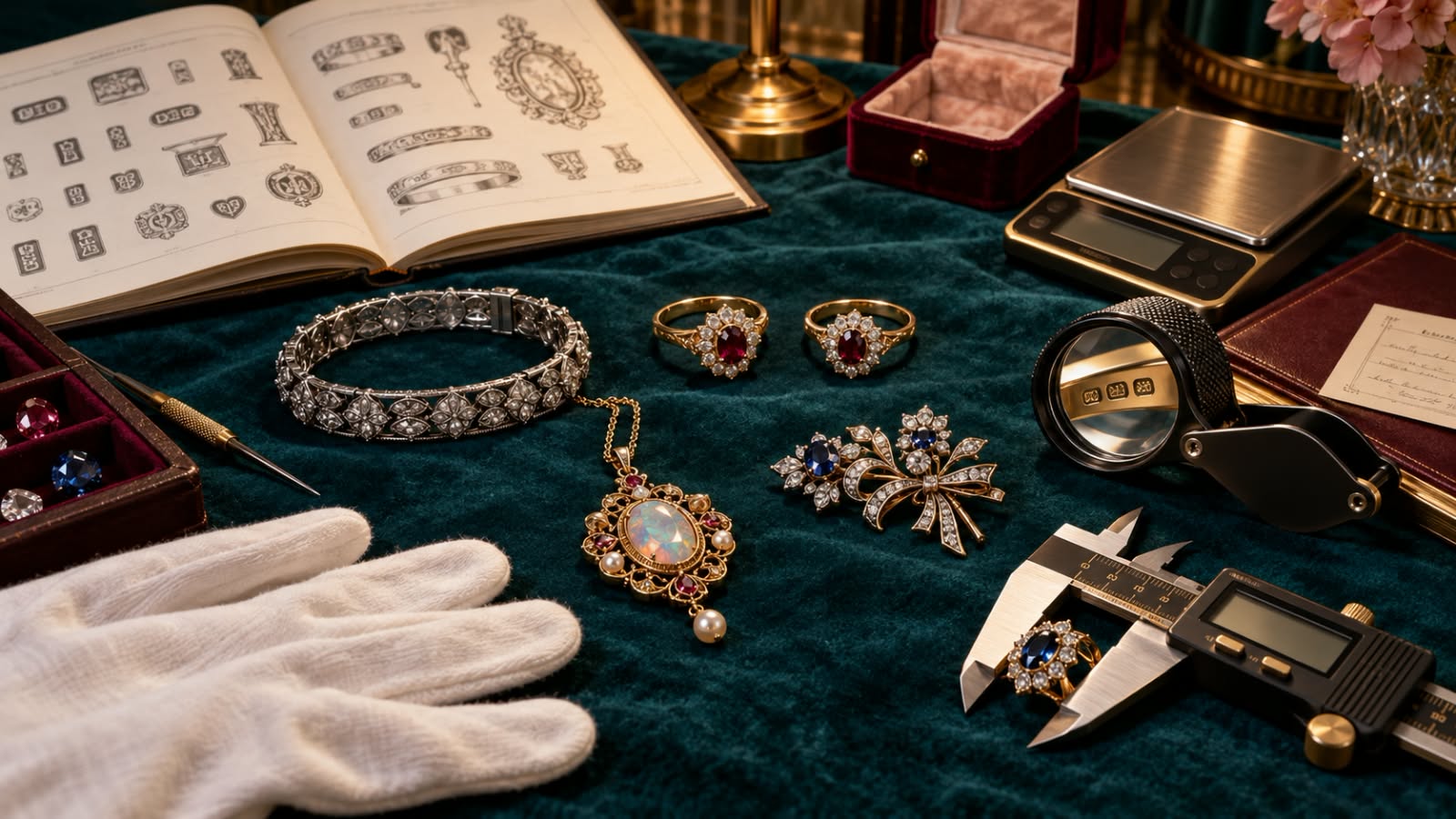
Is It Real? A Responsible Guide to Designer Jewellery Authentication
A piece of jewellery carries the name of a famous designer. The logo looks convincing, the metal is stamped and it may even arrive with a branded box.
Does that mean it is genuine?
Unfortunately, no.
Counterfeiters can copy stamps, logos, serial numbers, packaging and even certificates. At the same time, genuine vintage jewellery may have worn markings, replacement parts, missing paperwork or features that differ from pieces currently displayed on a brand’s website.
Designer jewellery authentication is therefore not about finding one magical clue. It means building a body of evidence and asking whether every part of the item tells a consistent story.
Here is how to approach that process responsibly.
A Designer Stamp Is Evidence—Not Proof
One of the most common mistakes is assuming that a stamped name automatically proves authenticity.
A counterfeit piece can be stamped:
- Tiffany & Co.
- Cartier
- Bulgari or Bvlgari
- Van Cleef & Arpels
- Chanel
- Dior
- Gucci
- Hermès
- Another recognised designer name
A false purity mark such as “925,” “750” or “18K” can also be added easily.
The presence of a stamp is therefore only the beginning of an investigation.
The correct question is not simply, “Does it have the right name?”
It is:
“Are the name, font, placement, materials, construction, model, age and provenance all consistent with a genuine item?”
Start by Establishing What the Item Claims to Be
Before examining tiny details, identify the claim being made.
Is the piece being offered as:
- A current designer model?
- A discontinued design?
- A vintage piece?
- A limited edition?
- Part of a recognisable collection?
- A collaboration?
- A sample or prototype?
- A custom alteration?
- An item made under an earlier version of the brand?
This matters because the expected marks, metals and construction can change over time.
A modern item can often be compared with the brand’s present catalogue. A vintage piece may require archived advertisements, old catalogues, auction records or reference books.
Do not assume that a piece is counterfeit merely because it does not appear on the current website. Brands discontinue designs, alter their markings and sometimes manufacture regional or limited collections.
However, claims such as “rare prototype” or “special edition” should be supported by evidence rather than used to explain every inconsistency.
Does the Brand Actually Make This Type of Jewellery?
Research whether the designer is known to have produced:
- That particular design
- That type of item
- Jewellery in the claimed metal
- That gemstone combination
- That fastening or construction
- Pieces in the stated period
This is especially important when an item appears in an unexpected material.
A luxury brand may produce both fine and costume jewellery. Another may use sterling silver extensively, while a different house may be best known for gold, platinum or fashion jewellery made from non-precious materials.
The fact that a brand is associated with luxury does not mean every genuine item bearing its name must be solid gold. Equally, the existence of some genuine silver pieces does not prove that every silver item carrying the logo is authentic.
Research the specific piece—not merely the general reputation of the brand.
Compare the Item With Confirmed Examples
Whenever possible, compare the piece with examples from reliable sources.
Useful sources may include:
- The designer’s official website
- Archived versions of the official website
- Original catalogues and advertisements
- Established auction houses
- Museum collections
- Recognised authentication services
- Reputable dealers specialising in that designer
- Reference books written by acknowledged experts
Look for an exact or closely related model rather than comparing it with any piece made by the same brand.
Ask:
- Are the proportions the same?
- Is the shape correct?
- Are the stones arranged identically?
- Is the clasp or hinge constructed in the same way?
- Are the edges, links and joins consistent?
- Does the genuine example have details missing from the item?
- Is the item unusually thick, thin, light or heavy?
- Are the marks placed in the expected location?
Online marketplace listings can be useful research leads, but they should not authenticate one another. Ten sellers repeating the same claim do not turn that claim into evidence.
Examine the Logo, Font and Spacing
Designer marks are usually applied according to specific production standards.
Under magnification, examine:
- The shape of each letter
- The spacing between letters
- Capitalisation
- Punctuation
- Accent marks
- Alignment
- Depth and sharpness
- Position on the piece
- Whether the mark follows the curve of the jewellery correctly
Warning signs may include:
- Unevenly spaced letters
- Misspellings
- Incorrect punctuation
- A logo that appears crooked
- Letters with inconsistent depth
- A mark that looks crudely scratched rather than deliberately applied
- A modern logo on a supposedly early piece
- Several marks in illogical or crowded positions
However, logo comparison is not foolproof.
Marks can vary between periods, workshops and production methods. Wear, polishing and repair may soften an authentic stamp. Conversely, modern counterfeiters may reproduce a logo with considerable accuracy.
The mark must be considered alongside the rest of the evidence.
Understand the Difference Between Brand Marks and Hallmarks
A designer’s name is not the same thing as an official hallmark.
In the United Kingdom, a complete compulsory hallmark normally contains marks identifying:
- The sponsor or person responsible for submitting the item
- The precious-metal fineness
- The assay office that tested and marked it
A date letter may also be present, but it is generally optional on modern pieces.
Small precious-metal items can fall below statutory hallmarking weight thresholds. Overseas pieces may also carry different forms of marking.
Therefore, the absence of a UK hallmark does not automatically prove that an item is counterfeit.
However, a brand name, “925” stamp or “18K” mark should not be described as a full UK hallmark unless it genuinely forms part of one.
A fake designer item may carry a genuine-looking purity number. A genuine designer item may also be made from costume materials and carry no precious-metal mark at all.
Brand authenticity and metal composition are related questions—but they are not the same question.
Test the Metal—but Understand What That Proves
Testing can help determine whether the jewellery is made from the metal it claims to contain.
Depending on the item and circumstances, assessment might involve:
- Visual examination
- Magnet screening
- Density or weight comparisons
- Electronic testing
- Acid testing
- X-ray fluorescence analysis
- Professional assay
No single screening test answers every question.
Testing a piece as sterling silver proves only that the tested area appears consistent with sterling silver. It does not prove that the designer manufactured it.
Similarly, discovering that an item is plated or made from an unexpected alloy may undermine an authenticity claim—but the result must be interpreted in the context of the brand, model and period.
There are also practical limitations. Plating, solder, surface contamination, repairs and mixed-metal construction can affect some tests.
Metal testing is evidence about composition, not an automatic certificate of designer authenticity.
Look Closely at Construction and Finish
Luxury jewellery is generally expected to meet a high standard of construction.
Examine:
- Solder joins
- Stone settings
- Hinges and clasps
- Link construction
- Edges and interior surfaces
- Symmetry
- Polish
- Engraving
- Under-gallery work
- Areas that are not normally visible while worn
Warning signs can include:
- Rough or unfinished edges
- Excess solder
- Poorly aligned settings
- Glue where the genuine design uses proper settings
- Sharp seams
- Hollow or lightweight construction where a confirmed example is solid
- Clasps that do not operate smoothly
- Uneven plating
- Stones set at inconsistent heights
- Decorative details that lose definition
Nevertheless, condition must be considered.
A genuine vintage piece may show wear, damage or an old repair. A replacement clasp does not necessarily make the entire item counterfeit, but it may affect originality and value.
The important question is whether the construction is consistent with the claimed maker and period.
Check Weight and Measurements
Counterfeit pieces sometimes differ noticeably in weight, thickness or dimensions.
If reliable specifications are available, compare:
- Total weight
- Diameter
- Width
- Chain length
- Link dimensions
- Band thickness
- Gemstone size
- Pendant proportions
An item made from a cheaper or less dense alloy may feel unusually light. However, weight alone is never conclusive.
Different sizes of the same ring will weigh differently. Brands may revise designs, and handmade pieces can show minor variations. Stones, repairs and altered components can also affect total weight.
Measurements are most useful when compared with a confirmed example of the same model and size.
Examine Serial Numbers and Reference Numbers
Some designer jewellery carries serial, edition, model or reference numbers.
Check whether:
- The format is appropriate for the brand
- The number is in the expected location
- The engraving style is consistent
- The number corresponds to the correct model or period
- The same number appears suspiciously often on unrelated online items
A serial number can be copied. Its presence does not establish authenticity.
In some cases, the brand or an authorised specialist may be able to confirm whether the format is plausible. Many brands, however, will not authenticate second-hand jewellery merely from photographs or serial numbers.
A number should support the evidence—not replace it.
Inspect the Gemstones
The gemstones should make sense for the item and its claimed value.
Consider:
- Whether the stones are natural, laboratory-grown or imitation
- Whether their quality is consistent with the brand
- Whether the cut style suits the claimed period
- Whether they are set or glued
- Whether the setting style matches confirmed examples
- Whether the stated gemstone combination existed in that collection
A luxury brand can use inexpensive ornamental stones intentionally, particularly in costume or fashion collections. Therefore, an inexpensive stone does not automatically indicate a fake.
Equally, a diamond tester cannot authenticate a designer jewel. It may help identify whether a stone behaves like diamond, but it does not prove who made the jewellery.
Packaging and Paperwork Can Also Be Counterfeit
Boxes, pouches, receipts, shopping bags and certificates can increase confidence—but they can also be purchased separately, reused or copied.
Check whether:
- The box is correct for the period
- The item fits the box properly
- Fonts and colours are consistent with official packaging
- The paperwork describes the actual item
- Dates, model numbers and prices make sense
- The seller’s story is internally consistent
A genuine box containing a counterfeit item does not make the item genuine.
Likewise, the absence of original packaging does not make vintage jewellery fake. Boxes are often lost over decades of ownership.
Treat packaging as supporting provenance, not conclusive proof.
Provenance: Where Did the Jewellery Come From?
Provenance means the documented history of an item.
Useful provenance may include:
- An original purchase receipt
- Insurance documentation
- An old valuation
- Service or repair records
- Auction records
- Family photographs showing the piece being worn
- Correspondence relating to the purchase
- A clear chain of ownership
A detailed story without documentation is still only a story.
That does not mean the seller is necessarily dishonest. Family histories can be sincere but mistaken. Memories fade, names become confused and items are placed in the wrong boxes.
Good provenance should fit the physical evidence.
Price Can Be a Warning Sign—but Not Proof
An implausibly low price should encourage caution.
However, genuine designer jewellery can be sold cheaply because:
- The seller does not recognise it
- It is included in a mixed job lot
- It is damaged
- It lacks documentation
- The resale market for that design is limited
- The seller needs a quick sale
Counterfeit jewellery can also be priced highly to create an impression of legitimacy.
Price is therefore part of the context, but it does not authenticate an item.
The old rule remains useful: if an offer appears too good to be true, slow down and investigate before buying.
Red Flags in an Online Listing
Exercise additional caution when:
- Photographs are blurry or heavily filtered
- The seller avoids showing the marks
- Only catalogue photographs are used
- The description makes guarantees without explaining the evidence
- The seller pressures buyers to act immediately
- Several supposedly rare pieces are available
- The seller refuses reasonable questions
- The same photographs appear on unrelated websites
- The item’s history repeatedly changes
- The price is explained through an elaborate but unsupported story
A responsible seller should be able to distinguish between what is known, what has been tested and what remains uncertain.
Can Jewellery Be Authenticated From Photographs?
Photographs can reveal important warning signs, but they have limits.
A knowledgeable person may be able to say:
- The model does not appear consistent with confirmed examples
- The mark looks unusual
- The construction raises concerns
- The materials appear inconsistent
- More evidence is required
That is not the same as issuing a definitive authentication.
Lighting, camera processing, scale and image quality can distort colour and detail. Photographs cannot reliably establish metal composition, gemstone identity or the microscopic features of an engraving.
For a valuable piece, physical examination is preferable.
Who Can Authenticate Designer Jewellery?
The appropriate expert depends on the item.
Options may include:
- The designer or brand itself
- An authorised retailer
- A recognised specialist authentication service
- A reputable auction house with expertise in that designer
- A qualified gemmologist
- An experienced jeweller or goldsmith
- A specialist in antique or vintage signed jewellery
A goldsmith can provide valuable evidence about construction, repairs and materials. A gemmologist can assess gemstones. An assay office can test precious-metal content.
However, expertise in one area does not automatically confer expertise in every designer’s archive.
For an important piece, several types of evidence may be required.
Authentication Is Not the Same as Valuation
These terms are often confused.
Authentication asks:
“Was this item genuinely made or authorised by the named designer?”
Metal testing asks:
“What metal does this item contain?”
Gemstone identification asks:
“What are these stones?”
Valuation asks:
“What is the item worth in a particular market and for a particular purpose?”
One professional may offer more than one of these services, but they are separate questions.
An item can be genuine but worth less than expected. It can contain genuine gold and diamonds but still be counterfeit as a branded product. It can also be unsigned, genuine period jewellery with considerable value despite having no famous name.
How Should a Responsible Seller Describe an Uncertain Piece?
If authenticity has not been established, the description should not present it as fact.
Safer wording may include:
- “Signed [brand name]; authenticity has not been independently verified.”
- “Attributed to [brand name], subject to further authentication.”
- “Designer-style piece; not sold as genuine [brand name].”
- “Metal tested as sterling silver; designer authenticity unconfirmed.”
- “Further specialist assessment recommended.”
Avoid using a brand name prominently in a way that implies authenticity while hiding the qualification in small print.
If the evidence strongly suggests that a mark is unauthorised, the item should not be marketed as genuine designer jewellery.
The Alex Ruby Approach: Buy the Evidence, Not the Confidence
At Alex Ruby, we believe confidence is not a substitute for evidence.
A seller may sound completely certain and still be mistaken. A stamp may look convincing and still be false. A box may be genuine while the jewellery inside it is not.
Responsible designer jewellery authentication involves asking:
- Does the exact model exist?
- Are the materials correct?
- Are the marks appropriate?
- Is the construction consistent?
- Does testing support the description?
- Is there reliable provenance?
- Has the item been examined by someone with the right expertise?
- Are any remaining uncertainties clearly disclosed?
Sometimes the honest conclusion is not “genuine” or “fake.”
Sometimes it is:
“We do not yet have enough evidence to say.”
That is not weakness. It is responsible jewellery selling.
Final Thoughts on Designer Jewellery Authentication
Designer jewellery can carry exceptional craftsmanship, history and value—but a famous name should never prevent us from asking sensible questions.
A logo is one clue.
A hallmark is one clue.
The metal, gemstones, construction, model, serial numbers, documentation and provenance are all further pieces of evidence.
The strongest conclusion comes when those details support one another.
So, before buying a supposedly rare designer bargain, look beyond the stamp. Research the model, examine the construction, test the materials where appropriate and seek specialist help when the value justifies it.
Buy the evidence—not merely the name.