
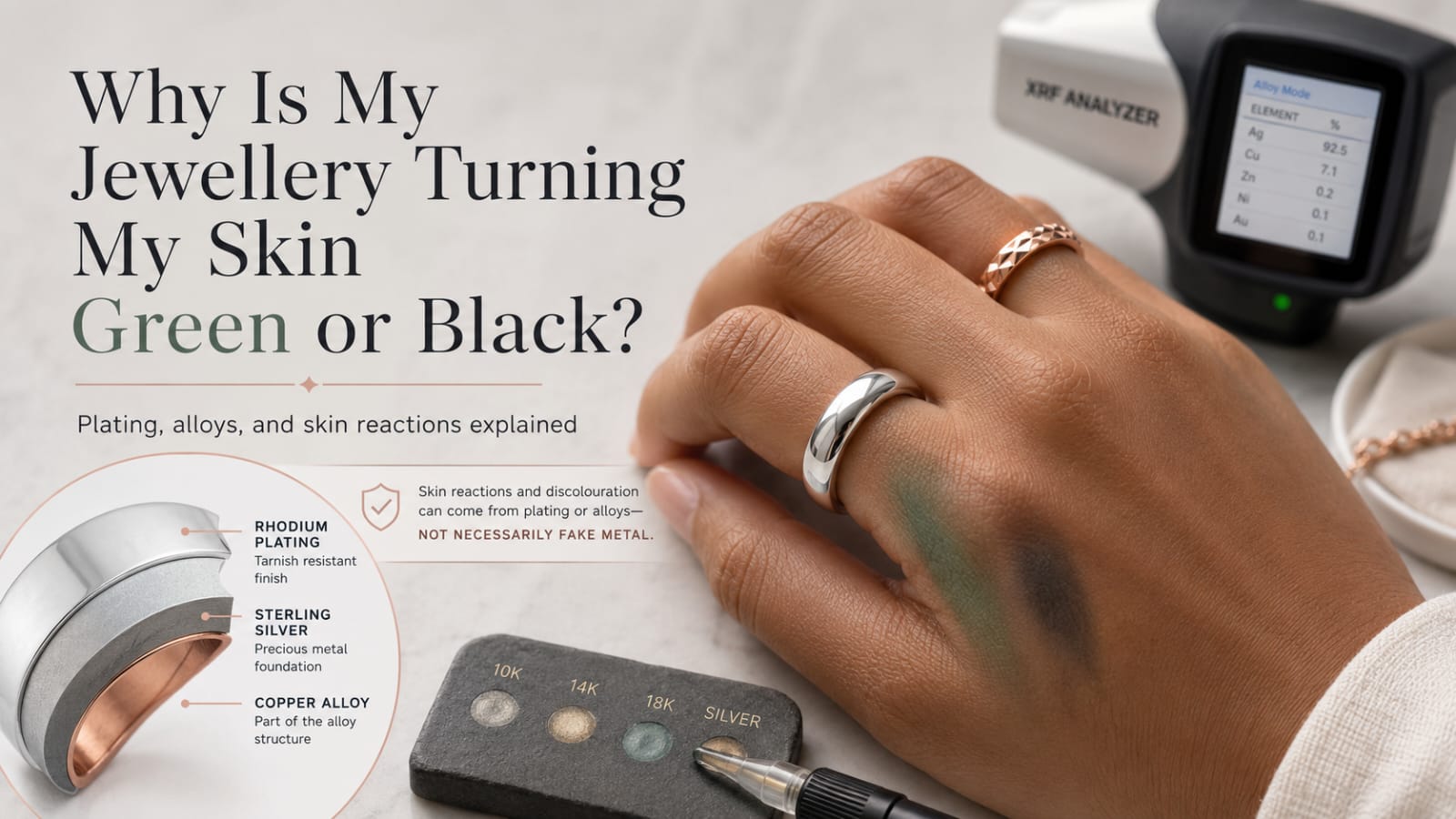
Why Does Jewellery Turn Skin Green? Precious Metals, Alloys and Plating Explained
You bought a silver ring.
Your finger went green.
Or perhaps you bought a gold necklace and noticed a dark mark around your neck.
Cue the inevitable:
“It must be fake.”
Not necessarily.
Welcome to the surprisingly complicated world of precious-metal alloys, plating, sweat, skin chemistry and jewellery testing.
One of the biggest misconceptions in jewellery is that genuine precious metal should never discolour the skin or cause irritation.
In reality, even perfectly genuine silver and gold jewellery can sometimes leave marks or contribute to skin reactions.
And there is a very simple reason:
Most jewellery is not made from pure metal.
Precious Metals Are Usually Alloys
Pure silver and pure gold are relatively soft.
For jewellery, they are usually combined with other metals to make them harder, stronger, easier to manufacture or to create a particular colour.
Take sterling silver.
Sterling silver — 925 silver — contains 92.5% silver.
So what makes up the remaining 7.5%?
Very commonly, copper.
Other silver alloys can also contain metals such as zinc or germanium depending on the formulation.
That means detecting copper in a sterling-silver item is not, by itself, evidence that the jewellery is fake.
Copper is often supposed to be there.
Gold Jewellery Works the Same Way
Gold jewellery is also usually an alloy rather than pure gold.
The carat tells you how much of that alloy is gold.
For example:
18ct gold = 75% gold.
The remaining 25% consists of other metals selected to provide strength, colour and other useful properties.
That means two genuine pieces of 18ct gold can have quite different alloy compositions.
What Is Yellow Gold Made From?
Yellow gold alloys can contain combinations of metals including silver, copper and zinc.
The precise recipe varies between manufacturers and carat levels.
What Is White Gold Made From?
White gold can contain metals including palladium, nickel, silver, copper and zinc.
White gold is also very commonly coated with rhodium to create the brilliant bright-white finish many people associate with modern white-gold jewellery.
Why Does Rose Gold Contain Copper?
And yes — copper is responsible for much of rose gold’s distinctive pink colour.
Increasing the proportion of copper changes the tone of the alloy from yellow towards pink or reddish shades.
That also explains why somebody may be perfectly comfortable wearing one type of gold alloy but experience staining or irritation from another.
The gold itself may not be the problem.
The alloy can matter just as much.
Does Green Skin Mean You Are Allergic to Jewellery?
Not necessarily.
This distinction is important.
If your finger turns green after wearing jewellery, that does not automatically mean you are experiencing an allergic reaction.
Copper can react with moisture, perspiration, cosmetics and substances in the surrounding environment to form copper compounds.
Those compounds can transfer onto the skin and leave the familiar green or blue-green stain.
The jewellery may still contain exactly the precious-metal content it is supposed to contain.
In other words:
Green finger does not equal fake jewellery.
And:
Green finger does not necessarily equal allergy.
An allergic contact reaction is more likely to involve symptoms such as redness, itching, eczema-like irritation, swelling or blistering.
Skin staining and skin allergy are different phenomena, although a person can of course experience both.
Why Can Jewellery Leave Black Marks on Skin?
Black or dark marks are not automatically proof of fake jewellery either.
Silver naturally tarnishes because of chemical reactions occurring at its surface, particularly involving sulphur-containing compounds in the environment.
Gold alloys can also occasionally leave dark markings on the skin.
There is even a recognised phenomenon often referred to as black dermographism, in which extremely fine particles of metal are abraded from jewellery and transferred onto the skin.
Cosmetics, powders and other substances can contribute to this effect.
So, surprisingly, a genuine gold ring can sometimes leave a dark mark.
That mark is not an assay result.
Your finger is not an XRF machine.
What About Rhodium Plating?
This is where jewellery testing becomes particularly interesting.
Precious-metal jewellery is frequently plated, and that is completely normal.
Sterling silver may be rhodium plated to create a brighter white appearance, improve surface finish, reduce tarnishing or provide a harder outer surface.
White gold is also very commonly rhodium plated.
So:
Rhodium-plated silver can still be silver.
And:
Rhodium-plated gold can still be gold.
The presence of a different metal at the surface does not automatically tell you that the underlying jewellery is base metal.
Can Rhodium-Plated Jewellery Cause a Skin Reaction?
Potentially, but skin reactions should not be diagnosed from the jewellery alone.
Rhodium sensitivity has been reported, although nickel is a much more familiar jewellery-related allergen.
If somebody develops irritation while wearing a plated piece, there may be several possible explanations.
The reaction could involve a metal underneath worn or porous plating, an intermediate plating layer, nickel in the alloy, cosmetics, soap, perspiration or another contact irritant.
That is why a skin reaction alone cannot identify which metal caused it.
Where an allergy is suspected, proper medical assessment — commonly including patch testing — is far more meaningful than guessing from the appearance or stated composition of the jewellery.
How Plating Can Affect XRF Jewellery Testing
XRF — X-ray fluorescence — is an extremely useful analytical tool for examining precious-metal composition.
An XRF analyser directs X-rays at an object and measures characteristic fluorescent X-rays produced by the elements present.
It can provide an enormous amount of information without normally damaging the jewellery.
But there is an important principle every tester needs to understand:
XRF analyses the material its X-rays can effectively interrogate.
A plated item is a layered object.
For example, it may consist of:
Rhodium
over
Sterling silver
or
Gold alloy.
Professional XRF equipment can even be used specifically to measure coating composition and thickness.
That tells us something very important: the coating itself matters to the measurement.
Depending on the coating, its thickness, the substrate underneath, the instrument, calibration and analytical method, plating can influence the apparent surface composition.
Good XRF interpretation therefore requires an understanding of how the jewellery is constructed.
“But My XRF Says Rhodium!”
That may be useful information.
It tells you that rhodium is present in the area being analysed.
It does not automatically tell you that silver or gold is absent underneath it.
Testing a plated object means analysing a layered system rather than a homogeneous piece of metal.
Professional laboratories use specialised methods when they need to distinguish coating composition, coating thickness and underlying substrate precisely.
This is why one surface reading should always be interpreted in context.
Plating Can Affect Acid Testing Too
Acid testing has a similar issue.
If the reagent only contacts the surface, then the surface is what is being tested.
Imagine an item constructed like this:
Rhodium plating
over
Sterling silver.
If the tester only touches the untouched outer coating, the result may primarily reflect that coating.
To investigate what lies underneath, the tester needs to expose the underlying metal sufficiently.
This is why traditional precious-metal testing often involves filing or creating a sufficiently deep scratch in an inconspicuous area before applying a reagent.
On a tiny charm, delicate article or heavily plated object, obtaining a genuinely representative sample may require more damage than the owner wishes to accept.
That does not mean acid testing is useless.
It means:
Test methodology matters.
“But I Scratched It!”
The next question is:
How deeply?
A superficial scratch through dirt, tarnish or only part of a coating may not necessarily expose material representative of the object’s underlying composition.
This is one reason no single precious-metal test should be treated as an infallible oracle.
At Alex Ruby, we prefer to think about jewellery testing as building a body of evidence.
Magnet testing. Visual inspection. Construction. Marks. Provenance. Acid testing. XRF where appropriate. And, when certainty genuinely matters, professional assay.
Each piece of evidence can tell you something.
The important part is understanding exactly what it can — and cannot — prove.
But Surely Precious Metal Shouldn’t React With Skin?
Remember what you are actually wearing.
A sterling-silver ring is not normally:
100% silver.
It is approximately:
92.5% silver + 7.5% other alloying metal.
And one of those alloying metals is very commonly copper.
Likewise, an 18ct rose-gold ring is not:
100% gold.
It contains:
75% gold + 25% other metals
with copper deliberately included to help create that distinctive rose colour.
Two people can therefore wear the same genuine piece of precious-metal jewellery and have completely different experiences.
One person’s skin does nothing.
Another person’s finger turns green.
Another develops irritation.
That tells us something about the interaction between the jewellery, the environment and the wearer.
It does not, by itself, establish the precious-metal content.
Jewellery Is Chemistry
Sweat contains water and salts.
Our jewellery comes into contact with hand cream, perfume, soap, moisturiser, sunscreen, makeup and cleaning products.
It is exposed to humidity, chlorine, sulphur compounds, pollution, detergents, acids and salts.
Then we combine several different metals and wear them against warm skin for hours at a time.
Chemistry happens.
That is normal.
So What Does a Green Finger Actually Prove?
Very little about the precious-metal content of the jewellery.
It may indicate that copper or another reactive metal is present or accessible at the surface.
That copper could be part of a base-metal object, a legitimate sterling-silver alloy, a gold alloy, deliberately included in rose gold, exposed through worn plating or present in another jewellery alloy altogether.
The skin stain alone cannot tell you which.
And that is really the point.
The Alex Ruby Rule: A Clue Is Not a Conclusion
We say this often because it applies to almost every form of jewellery testing:
A clue is not a conclusion.
A magnet test is a clue.
A hallmark is evidence.
An XRF reading is evidence.
An acid test is evidence.
A green finger is an observation.
None should be stretched beyond what it actually demonstrates.
Jewellery testing is not about finding one magic test that gives somebody permission to shout:
“FAKE!”
It is about understanding metallurgy, construction, plating, chemistry and the limitations of the testing method being used.
And sometimes the most scientifically responsible conclusion is simply:
“We need another test.”
That is not uncertainty to be embarrassed about.
That is good testing.
This article provides general educational information about jewellery, precious-metal alloys, plating and testing. Skin staining or irritation does not establish the composition of a jewellery item or identify an allergy. Persistent or significant skin reactions should be assessed by an appropriate medical professional, and precious-metal composition should be established using appropriate testing or professional assay where certainty is required.