
Precious vs Semi-Precious Gemstones: What Is the Real Difference?
Gemstones are often divided into two familiar categories: precious and semi-precious.
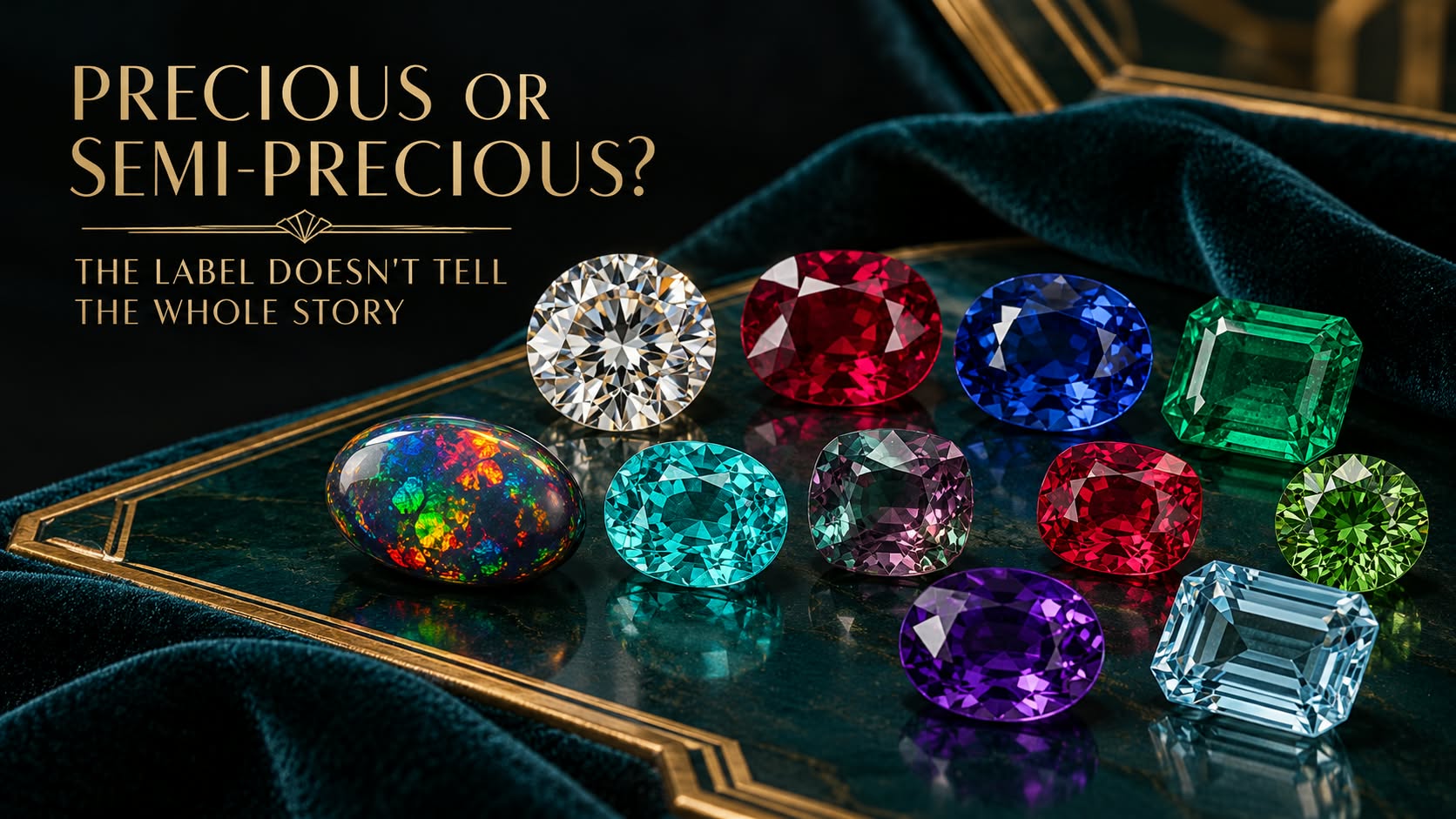
Traditionally, diamond, ruby, sapphire and emerald are described as the four precious gemstones. Almost every other gem—from amethyst and aquamarine to opal, tourmaline and garnet—falls into the enormous semi-precious category.
At first glance, this sounds like a straightforward way to separate the most valuable gemstones from the rest.
Unfortunately, it is not nearly that simple.
Some so-called semi-precious gemstones are considerably rarer and more valuable than many diamonds, rubies, sapphires or emeralds. Meanwhile, a poor-quality precious gemstone may be worth far less than an exceptional example from the supposedly lesser category.
So, what is the real difference between precious and semi-precious gemstones—and are these terms still useful?
What Are the Four Precious Gemstones?
Tradition identifies diamond, ruby, sapphire and emerald as the four precious gemstones.
- Diamond
- Ruby
- Sapphire
- Emerald
These stones became associated with wealth, royalty, power and ceremonial jewellery. Their desirability grew through historical scarcity, established trading networks and their use in important crowns, collections and religious objects.
However, the division was never based on a single scientific rule.
Diamond is a mineral composed of carbon. Ruby and sapphire are both varieties of the mineral corundum. Emerald is a green variety of beryl.
They do not belong to one mineral family, share one chemical composition or possess identical physical properties.
Instead, the precious category developed through a mixture of history, culture, fashion, availability and marketing.
What Are Semi-Precious Gemstones?
Traditionally, jewellers have described every gemstone outside the precious four as semi-precious.
That includes an extraordinarily diverse selection of gem materials:
- Alexandrite
- Amethyst
- Aquamarine
- Citrine
- Garnet
- Jadeite
- Kunzite
- Lapis lazuli
- Moonstone
- Morganite
- Opal
- Peridot
- Spinel
- Tanzanite
- Topaz
- Tourmaline
- Turquoise
- Zircon
These stones do not form one scientific or commercial group.
Some are transparent minerals that cutters transform into sparkling faceted gems. Others are opaque stones that jewellers polish into cabochons, beads or carvings. Availability varies enormously, with some gemstones found relatively easily and others exceptionally rare.
Placing all of them beneath the label “semi-precious” can therefore be deeply misleading.
Does Semi-Precious Mean Less Valuable?
No. Semi-precious does not automatically mean inexpensive, common or inferior.
An exceptional natural alexandrite with a strong colour change can be worth considerably more per carat than an ordinary diamond.
Fine Paraíba tourmaline can command extraordinary prices because of its vivid copper-caused blue or green colour and limited supply.
Top-quality jadeite, particularly highly translucent Imperial green jadeite, can sell for remarkable sums.
Other examples include:
- Fine red spinel.
- Demantoid garnet with exceptional colour.
- Black opal with vivid play-of-colour.
- Rare natural pearls.
- Unheated colour-changing gemstones.
- Fine tsavorite garnet.
- Collector-quality zircon.
- Rare varieties of tourmaline.
By contrast, commercial-quality diamonds can be relatively plentiful. Low-grade rubies and sapphires may contain heavy inclusions or undergo treatments such as filling and heating.
The label does not determine the value.
The individual gemstone does.
Why Is the Term Semi-Precious Misleading?
The word “semi” suggests that something is only partly precious.
However, a gemstone is not half beautiful, half rare or half desirable simply because it is not a diamond, ruby, sapphire or emerald.
The term can create several false assumptions:
- That all semi-precious gemstones are affordable.
- That all precious gemstones are expensive.
- That semi-precious stones are less durable.
- That precious gemstones are always rare.
- That one category is naturally superior to the other.
None of these statements is consistently true.
For this reason, many gemmologists and jewellery professionals prefer terms such as “gemstone”, “coloured gemstone” or the specific name of the material.
Describing a stone accurately as a natural untreated spinel, copper-bearing tourmaline or colour-change chrysoberyl tells us far more than simply calling it semi-precious.
What Actually Determines a Gemstone’s Value?
A combination of characteristics determines a gemstone’s value, rather than the category into which tradition places it.
1. Colour
Colour is one of the most important factors in coloured gemstone valuation.
Gemmologists consider:
- Hue, or the basic colour.
- Tone, meaning how light or dark it appears.
- Saturation, or the strength and intensity of the colour.
- Whether the colour is evenly distributed.
- Whether it has unwanted brown, grey or overly dark areas.
A vivid, beautifully saturated stone will usually be more desirable than a pale or muddy example of the same material.
However, the most valuable colour varies between gemstones. The ideal appearance of an emerald is different from that of a sapphire, tourmaline or garnet.
2. Rarity
Rarity can strongly influence value—but rarity alone is not enough.
A mineral can be extremely rare yet attract little demand because it is too fragile, unattractive or obscure for most buyers.
A gemstone becomes commercially important when rarity combines with beauty, durability and desirability.
Fine alexandrite, Paraíba tourmaline and red beryl are excellent examples of gems whose limited availability contributes significantly to their value.
3. Clarity
Clarity describes the internal and external features of a gemstone.
Buyers expect some gems to be relatively clean, while others naturally contain more inclusions.
For example, inclusions are common in emerald. A completely clean-looking emerald may therefore require especially careful examination to determine whether it is natural, synthetic or treated.
Inclusions do not always reduce value. They may prove natural origin, create an attractive optical effect or help identify geographical provenance.
Horsetail inclusions in demantoid garnet, for example, may be highly desirable. Fine rutile inclusions can create a star in sapphire or ruby.
Clarity must always be judged in the context of the particular gemstone.
4. Cut
A well-cut gemstone should display its colour and brilliance attractively while retaining an appropriate amount of the original rough material.
A poor cut may cause:
- A dull or lifeless appearance.
- Uneven colour.
- Dark areas.
- A transparent “window” through the centre.
- Poor symmetry.
- Unnecessary loss of weight.
Cutting coloured gemstones is often a balancing act. The cutter must consider colour direction, inclusions, durability, rarity and potential weight loss.
For particularly rare material, cutters may prioritise retaining weight over achieving perfect proportions.
5. Carat Weight and Size
Larger gemstones are not always more valuable, but fine large examples are usually less common than smaller ones.
Value per carat may rise sharply once a gemstone moves beyond the sizes normally produced by its deposit.
However, this varies by material. Large pieces of quartz may be readily available, while a clean alexandrite, ruby or Paraíba tourmaline of several carats may be exceptionally rare.
Carat weight should never be considered without examining the gemstone’s colour, clarity, cut and overall quality.
6. Treatments
Jewellers and gem processors treat many gemstones to improve their colour, clarity or durability.
Common treatments include:
- Heating.
- Irradiation.
- Dyeing.
- Oil or resin filling.
- Glass filling.
- Surface coating.
- Diffusion.
- Stabilisation.
Treatment does not automatically make a gemstone undesirable. The jewellery industry widely accepts some treatments.
Nevertheless, sellers must disclose treatments because they can affect value, durability and care requirements.
All other qualities being equal, an untreated natural gemstone will often be worth more than a comparable heavily treated example.
7. Natural, Synthetic or Imitation
A natural gemstone forms without human intervention, although it may later undergo treatment.
A synthetic gemstone has essentially the same chemical composition and crystal structure as its natural counterpart, but scientists grow it in a laboratory.
An imitation merely resembles another gemstone. It may be glass, plastic or a completely different mineral.
For example, a laboratory-grown sapphire is genuinely sapphire in its chemical and physical structure, but it is not a naturally mined sapphire.
Blue glass may imitate sapphire, but it is not sapphire at all.
Correct descriptions are therefore essential.
8. Origin
Geographical origin may add value when a particular source has developed a reputation for exceptional or historically significant gemstones.
Examples include:
- Kashmir sapphire.
- Burmese ruby.
- Colombian emerald.
- Russian alexandrite.
- Brazilian Paraíba tourmaline.
- Australian black opal.
Buyers should not assume geographical origin from appearance alone. Reliable geographic-origin opinions usually require examination by a respected gemmological laboratory.
A famous origin also does not guarantee quality. A poor-quality stone from a celebrated location may still be less desirable than a beautiful stone from another source.
9. Provenance and History
A gemstone set into an antique, historic or signed piece of jewellery may be worth more as part of the complete jewel than it would be as a loose stone.
Value may depend on:
- The jewellery maker.
- The design period.
- Previous ownership.
- Original documentation.
- Historical importance.
- Rarity of the complete piece.
- Quality of the craftsmanship.
Removing an old gemstone from its original setting can sometimes destroy part of the value one hoped to recover.
A Precious Gemstone Is Not Automatically More Durable
Another common misconception is that precious gemstones are always harder or more durable than semi-precious ones.
Diamond is the hardest natural material, scoring 10 on the Mohs hardness scale. Ruby and sapphire score 9, making them excellent choices for frequently worn rings.
Emerald, however, is more complicated.
Although emerald has a hardness of approximately 7.5 to 8, it often contains fractures and inclusions. Many emeralds undergo oil or resin treatments and require careful handling.
Several so-called semi-precious gemstones are also very suitable for jewellery. Spinel and chrysoberyl are notably durable, while topaz is hard but can split along its cleavage planes.
Turquoise, opal, moonstone and pearl require gentler treatment, yet their relative softness does not make them less beautiful or culturally important.
Hardness is only resistance to scratching. Durability also includes toughness, stability and resistance to heat, chemicals and sudden temperature changes.
Ruby and Sapphire Are the Same Mineral
One of the most interesting problems with the precious and semi-precious division is that ruby and sapphire are varieties of the same mineral: corundum.
Red corundum is called ruby.
Corundum of other colours generally carries the name sapphire. That includes familiar blue sapphire as well as pink, yellow, green, purple and colourless sapphire.
The boundary between pink sapphire and pale ruby can sometimes depend on laboratory or market conventions.
This is a wonderful example of how gemstone categories reflect language, history and trade practice as well as mineral science.
Emerald and Aquamarine Are Related Too
Emerald and aquamarine are both varieties of beryl.
Emerald owes its green colour primarily to chromium, vanadium or a combination of the two. Aquamarine usually receives its blue-to-greenish-blue colouring from iron.
Nevertheless, tradition places emerald in the precious category and aquamarine in the semi-precious category.
The stones belong to the same mineral family, yet history has placed them on opposite sides of an artificial dividing line.
Morganite, heliodor and colourless goshenite are also members of the beryl family.
What About Precious Opal?
“Precious opal” is a legitimate descriptive term, but it does not mean that opal has joined the traditional precious four.
Precious opal displays play-of-colour: shifting flashes of spectral colour that appear as the stone or light source moves.
Common opal does not display this effect.
In this context, “precious” identifies a type of opal rather than placing it inside the old precious gemstone category.
Similarly, the trade sometimes uses “precious topaz” for certain yellow, orange or pinkish topaz colours. Again, this is a variety or trade description rather than a universal gemstone classification.
Are Diamonds Actually Rare?
Fine natural diamonds with exceptional colour, clarity and size are genuinely rare.
However, diamonds also benefit from an extraordinarily successful international market, established grading systems and generations of advertising.
Producers supply substantial quantities of small commercial-quality diamonds.
Therefore, the statement “diamonds are rare” requires context. A large, naturally coloured blue or pink diamond may be phenomenally rare, while tiny lower-grade diamonds used in mass-produced jewellery are much more readily available.
As with every gemstone, quality matters.
Why Do Jewellers Still Use the Term Semi-Precious?
The phrase remains familiar to consumers and can be convenient when describing a broad collection of coloured gemstone jewellery.
A retailer might advertise “semi-precious gemstone rings” to distinguish them from diamond, ruby, sapphire or emerald jewellery.
The term does not necessarily indicate dishonesty. In many cases, it is simply traditional language that customers recognise.
However, it should not serve as a reliable valuation category.
At Alex Ruby, we believe that the specific gemstone, its quality, treatment, setting, craftsmanship and story are far more informative than whether tradition calls it precious or semi-precious.
Precious Metal and Precious Gemstone Mean Different Things
It is also important not to confuse precious gemstones with precious metals.
Gold, silver, platinum and palladium belong to the precious metals category. Specialists can measure and test their purity and, where required, verify it through hallmarking.
Gemstones are valued differently.
There is no single price per gram that can apply to every ruby, sapphire, garnet or tourmaline. Two stones of the same variety and weight can have dramatically different values because of their colour, clarity, cut, treatment and origin.
A gemstone’s identity is only the beginning of its valuation.
Questions to Ask When Buying a Gemstone
Whether a stone is traditionally called precious or semi-precious, sensible questions include:
- What is the gemstone?
- Is it natural or synthetic?
- Has it undergone treatment?
- Is the treatment stable?
- Does it require special care?
- Does documentation support the stated origin, or is it merely an assumption?
- Is there a laboratory report?
- Does the seller describe the stone accurately?
- Is the setting well made?
- Does the price reflect the complete jewel or only the loose gemstone?
For vintage and antique jewellery, it is also worth asking whether the stone appears original to the setting.
Replacement stones are not always a problem, but sellers should disclose them when they know about them.
Should We Stop Saying Semi-Precious?
Consumers still widely recognise the term, so it is unlikely to disappear overnight.
However, more precise language is usually better.
Instead of relying solely on “semi-precious”, we can say:
- Natural amethyst.
- Untreated spinel.
- Stabilised turquoise.
- Cultured pearl.
- Heat-treated sapphire.
- Natural colour-change chrysoberyl.
- Copper-bearing Paraíba tourmaline.
- Laboratory-grown emerald.
- Glass imitation opal.
These descriptions give buyers meaningful information.
“Precious” and “semi-precious” tell us very little about what a gemstone actually is.
Final Thoughts on Precious vs Semi-Precious Gemstones
The traditional distinction between precious and semi-precious gemstones is part of jewellery history, but it should not be mistaken for a scientific measure of quality or value.
Diamond, ruby, sapphire and emerald remain enormously important gemstones. Their beauty, durability and cultural history justify their lasting appeal.
However, they do not have a monopoly on rarity, desirability or value.
An extraordinary alexandrite, jadeite, Paraíba tourmaline, black opal, spinel or demantoid garnet may be rarer—and more expensive—than many examples from the precious four.
Ultimately, gemstones deserve individual assessment.
Their value lies in a combination of beauty, rarity, quality, treatment, craftsmanship, provenance and demand.
A gemstone does not become less special because somebody once placed the word “semi” in front of it.
Sometimes, the supposedly semi-precious stone is the greatest treasure in the room.