Happy Birthday, September! Your Birthstone Is Sapphire
September babies, this one is for you.
Your birthstone is sapphire — one of the most famous, durable and scientifically fascinating gemstones on Earth.
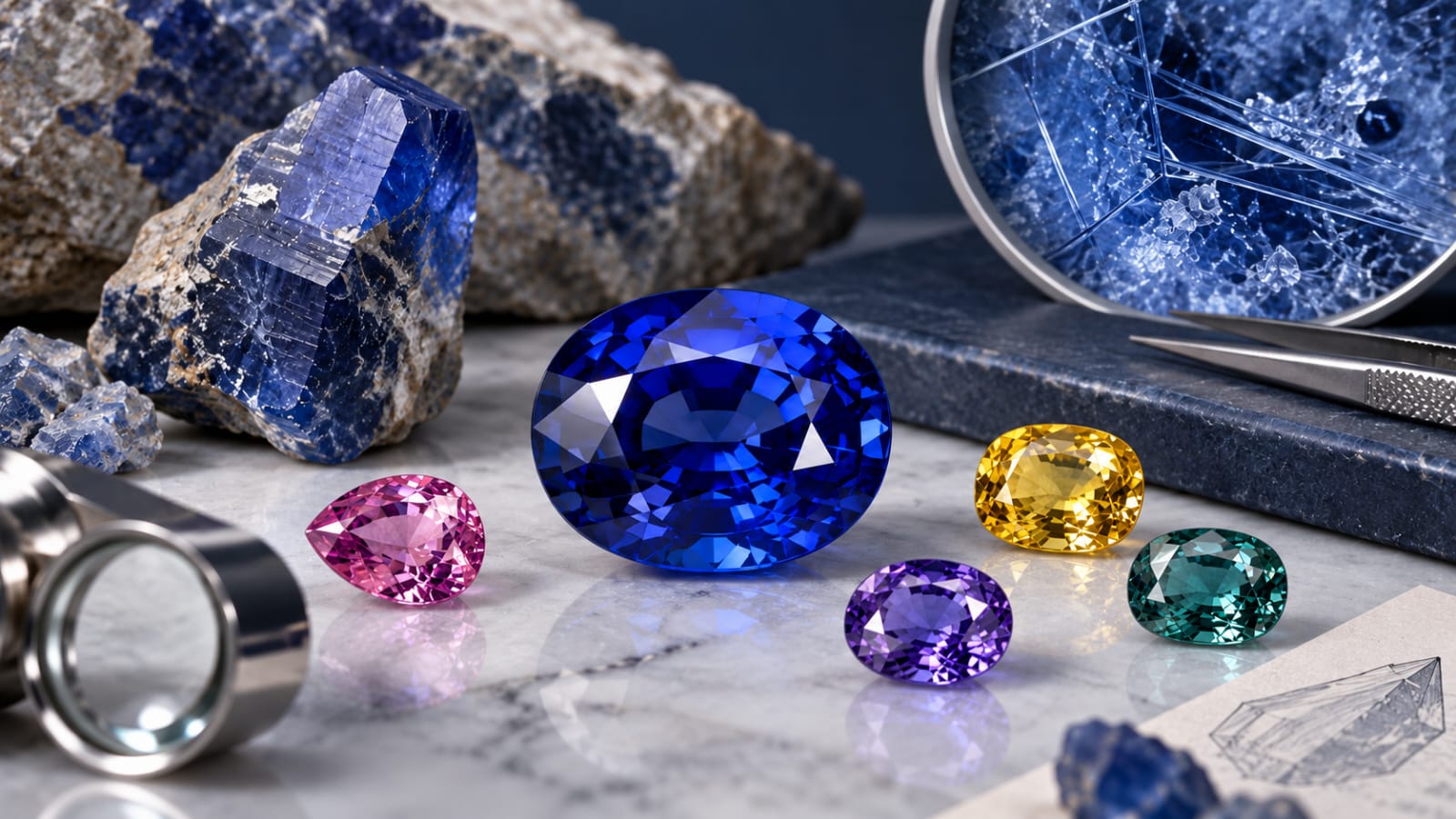
Most of us hear the word sapphire and immediately picture a deep royal-blue stone. But sapphire is actually an entire rainbow of gemstones. It can be blue, pink, yellow, orange, green, purple, violet, colourless, black, grey or even colour-changing.
And then things get even more interesting.
Natural sapphire can be heated. Sapphire can be grown in a laboratory. Natural and laboratory-grown sapphires can have essentially the same chemical composition. A gemstone tester can identify something as being consistent with sapphire without telling you whether it grew underground or inside a laboratory.
So, in honour of September, let’s get properly nerdy about sapphire.
First: What Exactly Is a Sapphire?
Sapphire is the gem variety of the mineral corundum.
Its basic chemical formula is:
Al₂O₃ — aluminium oxide.
That means a pure corundum crystal is built primarily from aluminium and oxygen.
Pure corundum is actually colourless. All those incredible sapphire colours are created when tiny amounts of other elements — sometimes only trace quantities — become incorporated into the crystal structure.
Corundum is also remarkably hard. It ranks 9 on the Mohs hardness scale, making it second only to diamond among the familiar traditional gemstones. That durability is one reason sapphire is such a good choice for jewellery intended to be worn regularly, including engagement rings.
And there is a slightly strange rule in gemmology:
Almost every colour of gem-quality corundum can be called sapphire — except red.
Red corundum gets its own name:
Ruby.
So ruby and sapphire are essentially members of the same mineral family.
How Does Nature Make a Sapphire?
This is where the geology becomes fascinating.
Natural corundum is comparatively unusual because aluminium is common in the Earth’s crust, but silicon is also extremely common. Under many geological conditions, aluminium combines with silicon and other elements to form entirely different minerals.
For corundum to crystallise, the geological environment has to be unusually favourable to aluminium oxide formation.
Natural sapphires can form through both metamorphic and magmatic geological processes.
Metamorphic sapphires can develop when enormous heat, pressure and chemical changes alter aluminium-rich rocks during events such as continental collisions and mountain building.
Other sapphires have magmatic origins associated with deep geological processes and certain volcanic environments. Some are ultimately transported towards the Earth’s surface by volcanic activity.
Once near the surface, their remarkable hardness and chemical resistance become useful again. Softer surrounding rock can weather away while the sapphire survives.
That is why sapphires are frequently recovered from secondary or alluvial deposits — gravels, riverbeds and sediments where durable sapphire crystals have accumulated after being released from their original host rock.
So that little sapphire in a ring may have survived extraordinary geological conditions, the destruction of the rock surrounding it and possibly a journey through ancient sediments before somebody eventually found it.
Not bad for a birthstone.
Why Are Sapphires Blue?
Remember that completely pure corundum is colourless.
Sapphire gets its colour because tiny amounts of other elements or defects within its crystal lattice affect which wavelengths of visible light are absorbed.
Blue sapphire is particularly interesting.
Its famous blue colour is principally associated with interactions involving iron and titanium in the corundum structure — particularly Fe²⁺ and Ti⁴⁺ ion pairs.
Those trace ingredients alter the way the crystal absorbs visible light, leaving us seeing blue.
And we are talking about tiny quantities. You do not need a sapphire to contain large amounts of iron and titanium to produce a dramatic colour.
But Sapphires Aren’t Just Blue
Different trace elements — and combinations of them — produce an extraordinary range of sapphire colours.
Pink sapphire is mainly associated with chromium. Increase the right kind of chromium influence sufficiently and, eventually, the colour moves into territory classified as ruby.
Yellow sapphire can be coloured by iron and particular electronic defects associated with iron within the crystal structure.
Purple and violet sapphires can involve chromium, vanadium and combinations of other colour-producing mechanisms.
Green and teal sapphires can result from combinations of the absorption mechanisms involving iron, titanium and other trace chemistry.
And then there is padparadscha sapphire — the famous and much-debated pinkish-orange to orangy-pink sapphire.
The science is actually more complicated than saying “one element equals one colour”. Natural stones are often influenced by combinations of colour-producing mechanisms rather than one isolated ingredient.
Think of the aluminium oxide crystal as the stage.
The trace elements are the lighting crew.
Tiny changes can completely alter the show.
Natural Sapphire vs Laboratory-Grown Sapphire
This is one of the most misunderstood areas of gemstone buying.
A laboratory-grown sapphire is not the same thing as blue glass pretending to be sapphire.
Nor is it the same as a sapphire-coloured piece of cubic zirconia.
Those would be imitations or simulants.
A laboratory-grown sapphire is synthetic corundum deliberately grown by people.
Laboratory-grown gemstones can have essentially the same chemical composition, crystal structure and physical and optical properties as their natural counterparts.
So:
Natural sapphire: Al₂O₃ corundum grown through geological processes.
Laboratory-grown sapphire: Al₂O₃ corundum grown through a controlled human process.
Blue glass: not sapphire.
That distinction matters.
The difference between natural and lab-grown sapphire is primarily origin and growth history, not simply basic chemical composition.
Synthetic sapphires have been commercially produced for more than a century, using methods including flame-fusion, flux, hydrothermal and other crystal-growth techniques.
So Can a Presidium Tester Tell Me Whether My Sapphire Is Natural?
No.
And this is a really important point.
A Presidium Gem Tester II works using the thermal properties of gemstones. It is designed to help separate a range of common coloured gemstones according to thermal conductivity.
But this type of gemstone tester does not distinguish natural from synthetic coloured gemstones.
Why?
Because natural sapphire and laboratory-grown sapphire have extremely similar fundamental physical and optical properties.
A thermal tester is measuring a property of the material.
It is not reading the stone’s geological birth certificate.
So if a tester gives a result consistent with sapphire, that can be useful evidence about the gemstone’s identity.
It does not prove that the sapphire is natural.
It also does not tell you whether the sapphire has been heat-treated.
That distinction applies far beyond sapphire:
Identifying what a gemstone is and determining where or how it formed are two different questions.
So How Do Gemmologists Tell Natural and Lab-Grown Sapphire Apart?
One of their most useful tools is surprisingly simple:
A microscope.
The things trapped inside a gemstone can tell a story about how that crystal grew.
Natural sapphire commonly contains features such as:
- fine rutile needles or “silk”;
- included mineral crystals;
- partly healed fractures that can resemble fingerprints;
- colour zoning or colour banding;
- negative crystals and fluid inclusions;
- clouds and other microscopic growth features.
One of the most beautiful is rutile silk.
These are extremely fine intersecting needles of rutile — titanium dioxide — inside the sapphire.
In sufficient quantities and in the right orientation, rutile silk can even create asterism, the optical phenomenon responsible for star sapphires.
But there is an important warning here:
Never identify a sapphire from one inclusion alone.
Laboratory-grown sapphires have their own characteristic growth features and inclusions, and some can be extremely convincing.
Depending on the manufacturing process, synthetic sapphires may show features such as curved growth structures, gas bubbles, flux residues or inclusions associated with crucible materials.
Professional gemmologists therefore look at the whole collection of evidence, not one exciting thing seen through a loupe.
Is a Perfectly Clean Sapphire Automatically Lab-Grown?
No.
Natural sapphires can have extremely high clarity.
Likewise, finding an inclusion does not automatically prove that the stone is natural.
The type, arrangement and character of those inclusions matter.
This is why a jeweller’s loupe can give you clues, while a reputable gemological laboratory can give you a far more defensible conclusion.
What About Heat Treatment?
Now we get to another hugely misunderstood subject.
Heat treatment of sapphire is extremely common and is an accepted practice within the gemstone trade.
A large amount of both blue and fancy-coloured sapphire in the market has been treated to alter its colour, either through conventional heating or other processes such as lattice diffusion. Heat is the most common traditional enhancement used for sapphire.
You will frequently hear the statement that most commercial sapphires are heated. The exact proportion varies enormously depending upon the type, origin, quality and section of the market being discussed, so be wary of anybody claiming one universal percentage.
The important point is:
Heating sapphire is normal.
What matters is that treatment is properly understood and disclosed.
What Does Heat Actually Do to a Sapphire?
Heating can alter the microscopic chemistry of the stone.
Depending upon the sapphire and the conditions used, treatment may:
- strengthen or modify its colour;
- produce or intensify blue;
- reduce unwanted colour components;
- improve apparent transparency;
- dissolve some of the fine rutile “silk”;
- alter existing inclusions;
- redistribute colour-producing elements within the crystal.
In blue sapphire, high-temperature heating can begin breaking down rutile inclusions. Titanium from that rutile can enter the surrounding corundum lattice and interact with iron, contributing to blue colour formation.
That microscopic change can itself leave evidence that trained gemmologists use when determining whether heating has occurred.
So heat treatment is not simply “cooking a gemstone until it looks nicer”.
There is some fascinating solid-state chemistry happening inside the crystal.
Does Heating Mean the Sapphire Is No Longer Natural?
No.
A natural sapphire that has been heat-treated is still a natural sapphire.
It formed in nature.
The correct description would be something such as:
Natural sapphire — heat treated.
That is completely different from:
Laboratory-grown sapphire.
The issue is disclosure, not whether heating somehow converts a natural crystal into a synthetic one.
Why Are Unheated Sapphires More Expensive?
Because beautiful natural sapphires that came out of the Earth with excellent colour and clarity without requiring enhancement are rarer.
Heating is an accepted sapphire treatment, but for fine-quality stones, independent confirmation that there is no evidence of heat can increase rarity and value.
That doesn’t mean an unheated sapphire is automatically prettier.
A gorgeous heated sapphire can be far more attractive than a dull untreated one.
But when comparing two otherwise exceptional natural sapphires, independently confirmed unheated status can command a substantial premium.
And that is exactly why expensive claims such as “unheated natural sapphire” should ideally be backed by a respected independent laboratory report rather than somebody simply looking at the stone and declaring it untreated.
Can Inclusions Tell Us Whether a Sapphire Was Heated?
Sometimes they provide very strong evidence.
Heat can change, dissolve or damage internal features.
For example, partially dissolved rutile silk and blue colour developing around remnants of rutile can provide evidence of high-temperature treatment.
Conversely, certain intact natural inclusions may indicate that a stone has not experienced high-temperature heating.
One particularly fascinating example involves carbon-dioxide fluid inclusions in some metamorphic corundum. Intact CO₂ inclusions can provide powerful evidence that high-temperature heat treatment has not occurred because those inclusions would not survive it intact.
This is gemstone forensics happening on a microscopic scale.
Heat Treatment Isn’t the Only Treatment
This is another reason the word treated needs more detail.
Traditional heat treatment is one thing.
Lattice diffusion is another.
Diffusion treatment combines heat with externally introduced chemical elements that migrate into the sapphire and alter its colour.
Diffusion-treated sapphires generally have lower values than otherwise comparable sapphires whose only enhancement is conventional heating, and both differ again from fine unheated material.
Other treatments can include fracture or cavity filling and, in some circumstances, dyeing.
So asking:
“Has this sapphire been treated?”
isn’t always enough.
A better question is:
“What treatment has this sapphire received?”
The Sapphire Testing Rule I Wish Every Buyer Knew
No single inexpensive machine gives you the entire answer.
A gemstone tester may help establish:
“The properties of this stone are consistent with sapphire.”
That is useful.
It does not automatically establish:
“This is a naturally mined, untreated sapphire.”
Those are completely different conclusions.
Determining natural versus synthetic origin and identifying treatment can require microscopy, refractive-index testing, spectroscopy, fluorescence examination, chemical analysis and other specialised gemological techniques.
For important or high-value sapphires, independent laboratory testing is the sensible way to establish those claims.
And Finally: Inclusions Aren’t Necessarily Flaws
One of my favourite things about natural gemstones is that their microscopic imperfections can actually be the most scientifically interesting part of them.
A tiny rutile needle may have been trapped while that crystal grew deep within the Earth.
A healed fracture records a geological injury the crystal survived.
Colour zoning can preserve changes in chemistry that occurred while different parts of the sapphire were growing.
A little mineral crystal trapped inside your sapphire might be older than the jewellery, older than humanity and older than almost everything you have ever touched.
Sometimes the thing we call an “inclusion” is actually a gemstone’s autobiography.
Happy Birthday, September
So if sapphire is your birthstone, you got a good one.
It is aluminium oxide transformed by geology, trace chemistry, heat, pressure and time into one of the world’s great gemstones.
It can be almost every colour imaginable.
It can contain microscopic evidence of the environment in which it grew.
It can be altered by heat without ceasing to be natural.
It can also be recreated remarkably faithfully in a laboratory — so faithfully that a simple thermal gemstone tester cannot distinguish laboratory-grown sapphire from its natural counterpart.
And perhaps most importantly:
A test result is evidence. It is not automatically the whole answer.
The more we understand what our jewellery actually is — and what our testing equipment can and cannot tell us — the better buyers, collectors and sellers we become.
Happy birthday, September.
Your birthstone has quite a story.
This article is intended for general jewellery and gemstone education. Identification of gemstone origin and treatment can require specialist gemological examination and laboratory testing.