

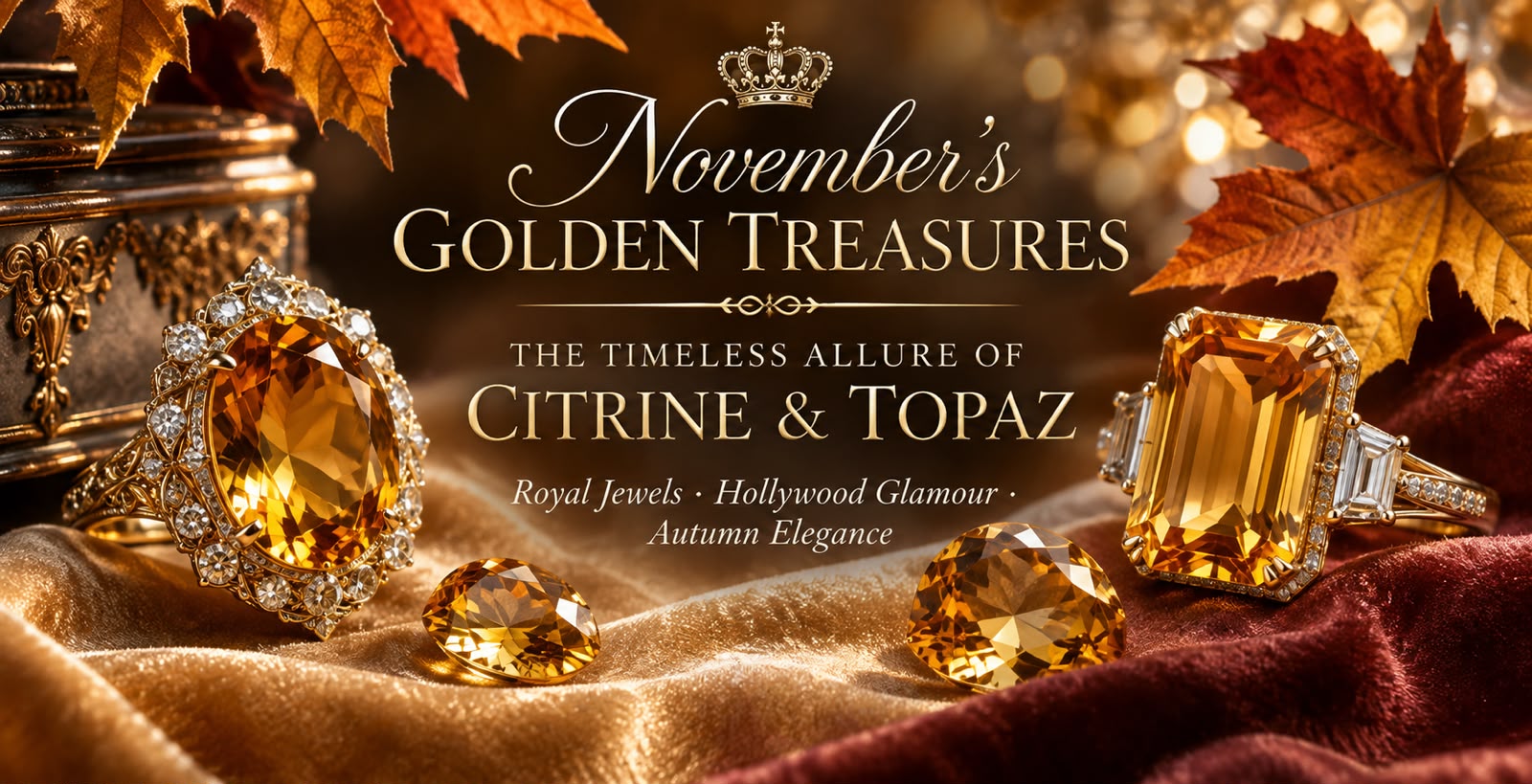
November’s Golden Treasures: The Timeless Allure of Citrine and Topaz
Two beautiful birthstones, a history of royalty and Hollywood glamour, and the golden warmth of autumn.
As November arrives and the golden colours of autumn begin to fade into winter, two gemstones seem perfectly suited to the season. Citrine and topaz, with their beautiful golden, honey and amber hues, bring warmth, elegance and a little sunshine to the darker days.
But these gemstones are far more than simply November’s birthstones. They have fascinating histories, have adorned royalty and Hollywood stars, and continue to captivate jewellery lovers with their beauty, versatility and symbolism.
From antique Victorian brooches to glamorous Art Deco cocktail rings, let’s explore why citrine and topaz have earned their place in the world of fine and vintage jewellery.
Citrine: A Little Piece of Sunshine
Few gemstones capture the warmth of autumn quite like citrine.
A member of the quartz family, citrine ranges from delicate lemon yellow to rich golden honey and deep, reddish-orange Madeira shades. Its name comes from the French word citron, meaning lemon, reflecting its characteristic yellow colouring.
Citrine has been treasured for centuries, although its history is intertwined with that of other yellow gemstones. Before modern gemmology could reliably distinguish minerals, people frequently mistook citrine for topaz. The two stones are entirely different minerals, despite their similar appearance.
A Gemstone Associated with Prosperity
Throughout history, people have associated citrine with happiness, abundance and good fortune. Its golden colour naturally evokes sunshine and precious gold, making it a popular choice for those who appreciate both its beauty and symbolism.
Ancient civilisations used yellow quartz in jewellery and decorative objects, while later generations embraced citrine for rings, brooches, pendants and other ornamental pieces.
Today, citrine remains particularly appealing because it offers the appearance of a substantial, colourful gemstone without necessarily commanding the prices associated with rarer precious stones.
For vintage jewellery enthusiasts, its versatility is especially attractive. Citrine looks magnificent in yellow gold, where the richness of the setting enhances its warm colour. Equally, it can create a striking contrast alongside diamonds or within intricate antique-inspired designs.
Queen Victoria and the Royal Love of Citrine
Citrine’s royal connections are particularly fascinating.
Queen Victoria was known for her love of colourful jewellery, and citrine became associated with fashionable jewellery of the Victorian period. Its warm golden tones suited the rich colours and elaborate designs favoured during the nineteenth century.
This historical connection helps explain why citrine remains so appealing to collectors of Victorian jewellery. A beautifully cut golden gemstone in an ornate brooch or ring can evoke the elegance of an entirely different age.
Royal interest in citrine has continued into modern times. Catherine, Princess of Wales, has worn citrine jewellery on several occasions, demonstrating how a gemstone with a long historical tradition can look equally elegant in contemporary settings.
Citrine and the Princess of Wales
One particularly memorable example came in January 2023, when the Princess of Wales wore a golden citrine pendant necklace while hosting a reception for England’s wheelchair rugby league team at Hampton Court Palace.
Reports identified her necklace as the Citrine Baby Treasure Necklace by British designer Daniella Draper.
The rich golden gemstone complemented her burgundy outfit beautifully, demonstrating how citrine can add warmth and sophistication to an understated ensemble.
For jewellery lovers, this was a lovely reminder that a gemstone does not need to be a diamond, ruby or sapphire to make an impression. Sometimes, the appeal lies in the colour, character and simplicity of the piece itself.
The Princess has also worn citrine earrings by British jewellery designer Kiki McDonough, whose colourful gemstone designs have become familiar features of her jewellery collection.
These royal appearances have helped bring renewed attention to citrine, particularly among those who appreciate elegant, wearable jewellery with a story behind it.
Topaz: A Gemstone Fit for Royalty
If citrine represents the warmth of autumn sunshine, topaz offers an altogether different kind of fascination.
Topaz is a distinct mineral that occurs in a remarkable variety of colours, including colourless, blue, yellow, pink, brown and orange. Although many people immediately think of blue topaz, the golden and orange varieties are particularly associated with November.
Yellow topaz has a long history as a traditional November birthstone, while citrine became an established alternative in modern birthstone lists.
The Beauty of Golden and Imperial Topaz
Among the most admired varieties is imperial topaz, known for its beautiful golden-orange, peach and pinkish-orange hues.
Fine imperial topaz can be exceptionally desirable, particularly when the colour is rich and evenly distributed. Unlike more common varieties of topaz, fine imperial examples can command substantial prices.
This makes it especially interesting to collectors who enjoy exploring the differences between gemstones that might initially appear similar.
A golden topaz ring and a citrine ring may look remarkably alike at first glance, but they have different mineral compositions and physical properties. Correct identification plays an important role in understanding their value.
Topaz is also relatively hard, measuring 8 on the Mohs hardness scale. However, its pronounced cleavage means it can split following a sharp impact. A well-designed setting and sensible care are therefore important, particularly for rings intended for regular wear.
A History of Wealth and Good Fortune
Golden topaz has traditionally symbolised wealth, wisdom and good fortune.
Its golden colour recalls precious metals, particularly gold, while historical beliefs sometimes linked the stone with attracting prosperity.
Although these associations belong to symbolism and folklore rather than scientifically established effects, they contribute to the personal meaning that makes birthstone jewellery so appealing.
For someone born in November, a topaz ring or pendant can represent more than an attractive accessory. It can become a personal keepsake, marking a birthday, an important anniversary or a meaningful moment in life.
Hollywood Glamour: Citrine’s Golden Age
Citrine has also enjoyed a remarkable place in the history of Hollywood jewellery.
During the early and middle decades of the twentieth century, large, colourful gemstones became an important part of glamorous fashion. Citrine was particularly well suited to the dramatic jewellery styles of the period, especially when jewellers combined it with yellow gold.
One of the most famous admirers of citrine was Hollywood actress Joan Crawford.
Crawford’s extraordinary citrine jewellery suite, created by American jeweller Raymond C. Yard, included a necklace featuring a spectacular 357.6-carat citrine and a bracelet set with a 116-carat stone.
The jewellery became associated with her glamorous public image and appeared in the 1941 film When Ladies Meet.
The scale of these gemstones illustrates something important about citrine: it can create an impressive visual statement without relying on the conventional prestige of diamonds.
Its rich colour, generous proportions and striking appearance make it particularly suited to vintage cocktail jewellery.
Angelina Jolie’s Extraordinary Citrine Necklace
A more contemporary example is the magnificent citrine necklace associated with actress Angelina Jolie and jewellery designer Robert Procop.
The piece, which they created as part of their Style of Jolie collection, features 64 graduated cushion-cut citrines set in 18-carat yellow gold, culminating in an extraordinary pear-shaped citrine weighing 177.11 carats.
Jolie and Procop donated the necklace to the Smithsonian’s National Museum of Natural History in 2015.
The necklace is a wonderful example of how thoughtful design, craftsmanship and the selection of an impressive central gemstone can transform citrine into a remarkable piece of jewellery.
It also demonstrates that citrine can occupy a place in important jewellery collections alongside far more famous and expensive gemstones.
Why Are Citrine and Topaz So Popular in November?
There are several reasons these two gemstones remain so closely associated with November.
1. Their Colours Reflect the Season
November is a month of golden leaves, coppery foliage and warm autumn colours. Citrine and golden topaz capture these shades beautifully, making them natural choices for jewellery inspired by the season.
2. They Symbolise Warmth and Optimism
People have traditionally associated both gemstones with positive qualities such as happiness, prosperity and good fortune. Their sunny colours offer a pleasing contrast to the darker days of late autumn.
3. They Have a Fascinating History
From Victorian jewellery and royal collections to Hollywood’s most glamorous stars, citrine and topaz have stories that extend far beyond their role as birthstones.
4. They Offer Excellent Design Versatility
Both gemstones work beautifully in yellow gold, white gold and other precious-metal settings. Jewellers can incorporate them into delicate everyday jewellery or substantial statement pieces.
5. They Offer Choices for Different Budgets
Many examples of citrine and topaz are relatively accessible, allowing jewellery lovers to choose beautiful gemstones in a variety of sizes and designs. However, fine imperial topaz and exceptional stones can be considerably more valuable.
Their accessibility, combined with their beauty, makes them appealing to both new jewellery buyers and experienced collectors.
The Vintage Jewellery Connection
For anyone who appreciates antique and vintage jewellery, November’s birthstones are particularly rewarding to explore.
Citrine has a strong association with Victorian and later vintage jewellery, while its rich colour works especially well in Art Deco-inspired designs.
Imagine a large, golden citrine surrounded by sparkling white stones in an elegant yellow-gold ring. Alternatively, picture an ornate vintage brooch with a substantial honey-coloured gemstone catching the light.
These are pieces that can feel both timeless and individual.
Topaz offers equally interesting possibilities, from antique golden stones to more contemporary designs featuring pink, orange or blue varieties.
When examining vintage jewellery, it is worth looking beyond the gemstone alone. The quality of the setting, the craftsmanship, the condition of the piece and any evidence of age or provenance can all contribute to its appeal.
For collectors, discovering a beautiful piece is often about finding something that combines visual beauty with history and individuality.
A Jeweller’s Final Thoughts
Citrine and topaz remind us that the world of gemstones extends far beyond the traditional favourites.
Their appeal lies in their colour, fascinating histories and ability to make a piece of jewellery feel personal.
Citrine offers warmth, golden brilliance and an association with prosperity. Meanwhile, topaz brings extraordinary colour variation, elegance and, in its finest imperial forms, the excitement of rarity.
Both have adorned royalty, attracted the attention of Hollywood and inspired generations of jewellery designers.
For those born in November, either gemstone makes a meaningful birthstone choice. Collectors of vintage and antique jewellery will also find wonderful opportunities to discover pieces with character and history.
Ultimately, the best gemstone is not necessarily the rarest or the most expensive. It is the one that captures your imagination, suits your style and gives you pleasure every time you wear it.
And perhaps that is the real magic of November’s golden birthstones: they remind us that beautiful jewellery is not simply about what we own, but the stories we choose to carry with us.