

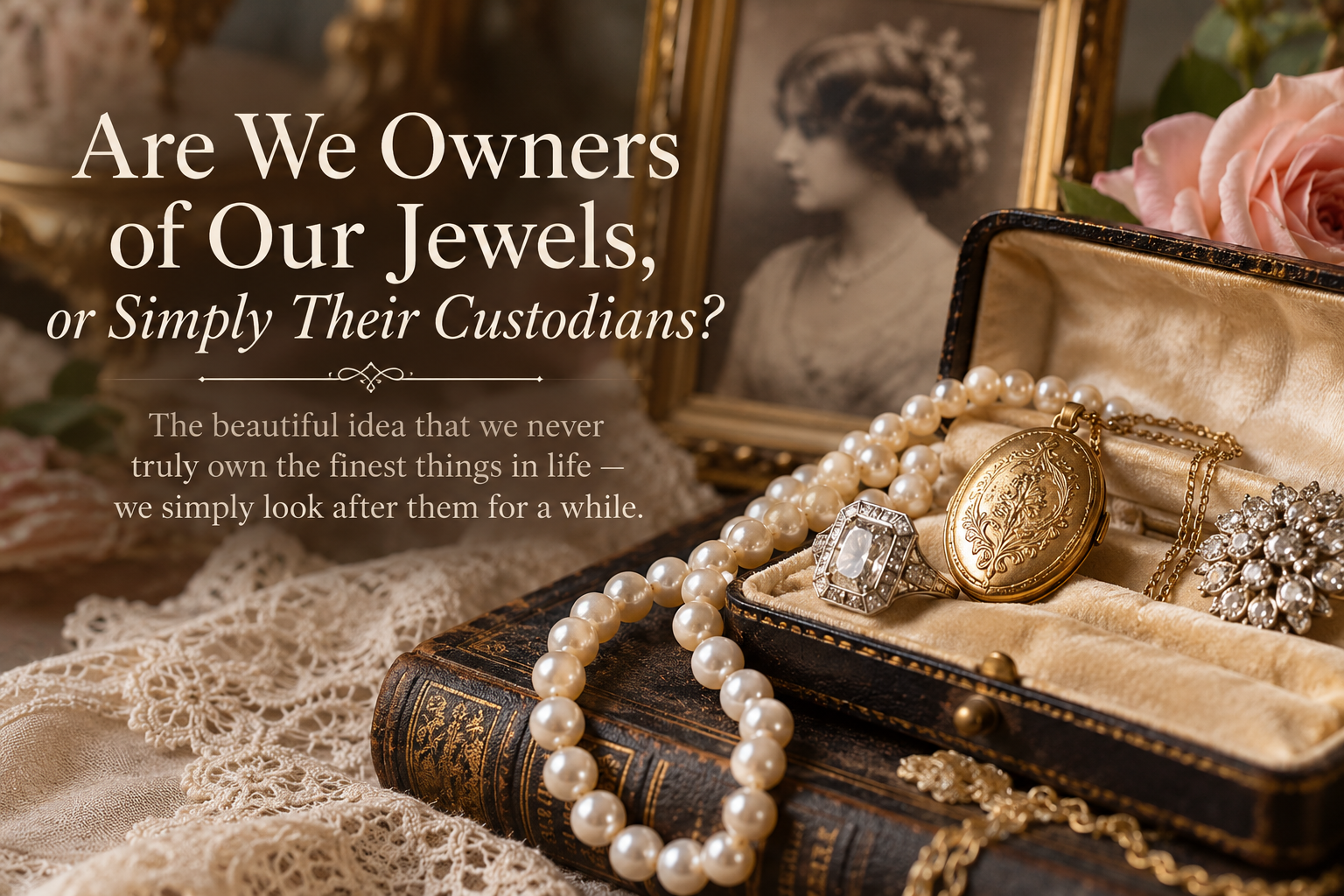
Are We Owners of Our Jewels, or Simply Their Custodians?
The beautiful idea that we never truly own the finest things in life — we simply look after them for a while.
There is something quite magical about holding a piece of antique jewellery that has lived a hundred years before it ever found its way into your hands.
Perhaps it is a Victorian gold locket, its surface softened by time. Or an Art Deco diamond ring that once graced the finger of a lady whose name history has long forgotten. It might even be a string of pearls passed down through generations, each pearl carrying its own quiet history.
When we buy a piece of jewellery, we naturally think of it as ours. We have paid for it, chosen it and perhaps fallen in love with its beauty. We place it in our jewellery box, wear it on special occasions and take pleasure in knowing that it belongs to us.
But have you ever stopped to consider whether we are truly the owners of these treasures, or whether we are simply their custodians?
This idea has fascinated collectors, jewellers and lovers of antiques for generations. The more you explore the world of fine jewellery, the more compelling the distinction becomes.
The Difference Between Owning and Being a Custodian
Ownership is straightforward. You purchase a ring, a necklace or a beautiful antique brooch, and it becomes your property. You have the right to enjoy it, wear it, sell it or pass it on, subject to the usual legal considerations.
Custodianship, however, offers a rather different perspective.
A custodian recognises that an object may have a life far greater than the time it spends in any one person’s possession.
Think about an antique diamond ring made in the nineteenth century. A skilled goldsmith may have created it for a young woman to wear on her wedding day. Her daughter might later have inherited it, followed by a granddaughter who treasured it before the ring eventually entered the antique jewellery market.
When you acquire that ring today, you become the latest person in a much longer story.
You may be its legal owner, but you also take responsibility for preserving its beauty, protecting its craftsmanship and ensuring that its history survives.
In a sense, you are looking after something that has already survived generations and may continue to do so long after you are gone.
Perhaps the most beautiful way to think about antique jewellery custodianship is this: we own it in the present, but we hold its history in trust for the future.
Jewellery Is More Than Its Materials
It is easy to place a monetary value on jewellery.
Jewellers can weigh gold, grade diamonds and assess gemstones. Hallmarks can also help us understand the metal from which a piece was made.
These details matter enormously, particularly when buying or selling fine jewellery.
But they do not tell the whole story.
Consider a simple gold locket. Its intrinsic value might depend on the weight of its gold and the quality of its workmanship. Yet, hidden inside, there may be a tiny photograph of someone who lived in another century.
That photograph could represent a marriage, a family or a love story that has otherwise disappeared from the historical record.
Would we value that locket in quite the same way if we knew nothing about its past?
Probably not.
Its material value would remain, but we would lose something of its emotional and historical significance.
The same can be said of antique engagement rings, mourning jewellery, Georgian brooches and Victorian lockets. Their original owners did not acquire these objects merely to admire them behind glass. They wore, loved, gifted and remembered them.
They are tangible connections to lives that came before ours.
When we recognise this, jewellery becomes something more meaningful than a possession.
It becomes a small piece of human history.
The Generations Before Us
One of the most wonderful aspects of antique and vintage jewellery is the thought that someone else once treasured the very object we now hold.
Imagine a Victorian bracelet that has passed through three generations of a family.
Perhaps someone gave it as a wedding present in 1885. Its owner might have worn it at family celebrations, wrapped it carefully in tissue paper during difficult times and eventually placed it in a drawer when fashions changed.
Decades later, it finds its way into the hands of a new collector.
The bracelet may have changed hands, but its craftsmanship remains. The goldsmith’s work is still visible. The clasp still functions. Its decorative details continue to catch the light.
The journey continues.
There is something deeply moving about this idea. The original owner could never have imagined the world we live in today, yet a small object connected to their life has survived to reach us.
We may know nothing about them. Their name might remain a mystery.
But we can still appreciate the care, skill and sentiment that went into creating the piece.
In this way, jewellery can become a bridge between generations, connecting people who will never meet.
And perhaps that is one of the reasons we are so drawn to it.
The Responsibility of a Jewellery Custodian
If we begin to see ourselves as custodians of jewellery, our relationship with it changes.
We become more interested in preserving a piece than simply possessing it.
This does not mean that every antique ring must remain untouched in a safe, or that beautiful jewellery should never see the light of day. Quite the opposite.
Jewellery exists to be enjoyed.
A beautiful Art Deco ring deserves to see daylight. A Victorian brooch deserves a place on a coat. A string of pearls should have the opportunity to accompany someone to a special occasion.
The responsibility lies in enjoying these treasures while respecting their age, materials and construction.
That might mean asking a qualified jeweller to check an antique clasp before you wear a necklace. It could mean storing pearls separately from harder gemstones to prevent scratches, keeping jewellery away from harsh chemicals and arranging appropriate cleaning or repairs.
It may also mean resisting the temptation to make unnecessary alterations that could compromise a piece’s original character.
Sometimes, a little wear is part of a jewel’s story. The important thing is to understand the difference between the gentle signs of age and damage that could threaten its survival.
A good custodian appreciates that preservation is not about freezing an object in time. It is about giving it the best possible chance of continuing its journey.
Should We Leave Antique Jewellery Exactly as We Found It?
This is an interesting question, particularly in the world of antique jewellery.
Some collectors believe that a piece should retain its original condition wherever possible. Others feel that jewellery should evolve with its owner, perhaps through careful restoration or sympathetic adaptation.
There is no single answer that suits every piece.
Collectors may particularly value a Georgian ring for its original setting, construction and historical character. Making substantial changes could diminish its significance.
On the other hand, a necklace with a damaged clasp may need a professional repair before its owner can wear it safely.
The key is to understand what makes the piece special before making a decision.
Is it the original workmanship? The gemstones? The historical setting? The evidence of a particular period? Or is there a personal reason for adapting it?
A thoughtful approach considers both the needs of the present owner and the importance of preserving the object’s past.
After all, being a custodian does not mean we cannot make a piece our own.
It simply means we should do so with care and understanding.
The Emotional Value of Jewellery
Not every treasured piece of jewellery is particularly old or financially valuable.
A modest gold wedding band may be worth relatively little in material terms, yet hold extraordinary significance because it belonged to a beloved parent.
Someone might have purchased a silver brooch on a memorable holiday. A pair of earrings may have marked a special birthday.
These objects carry personal stories that cannot be measured by an auction estimate.
This is where the idea of custodianship becomes especially powerful.
We may inherit jewellery that we would never have chosen ourselves. Sometimes we receive pieces that do not suit our style, or discover items whose history remains partly unknown.
Yet, rather than seeing them simply as things to keep or sell, we can take a moment to understand what they represent.
Learning about the period in which a piece was made can help us appreciate its beauty. A family story may give it new meaning. At other times, the simple act of preserving it for another generation is enough.
We do not have to wear every piece we inherit to value it.
Nor do we have to keep every family heirloom forever to respect the people who came before us.
What matters is making thoughtful decisions about the objects that have come into our care.
Passing the Story On
One day, every piece of jewellery we own will belong to someone else, whether through inheritance, resale, gifting or donation.
That thought can be surprisingly liberating.
We are reminded that the pleasure of owning jewellery does not have to depend on keeping it for the rest of our lives.
A ring might have been part of your collection for twenty years before you decide to pass it on to someone who will appreciate it more.
You might sell a vintage brooch to fund a new purchase, allowing the brooch to begin another chapter with a different collector.
Alternatively, you may leave a cherished necklace to someone you love, together with the story of how it came into your possession.
In each case, the jewel continues its journey.
This is particularly important when we consider the skills involved in creating fine jewellery. Many antique pieces represent craftsmanship that modern jewellers would find difficult, time-consuming or expensive to reproduce.
By preserving them, appreciating their construction and passing them on, we help keep that craftsmanship visible and valued.
We also help ensure that future generations can experience the beauty of objects created in another age.
And that, surely, is something worth protecting.
A Different Way to Collect Antique Jewellery
For those of us who love jewellery, thinking like a custodian can change the way we collect.
Instead of asking only, “How much is this worth?” we might also ask:
- What can this piece tell me about the period in which it was made?
- What makes its craftsmanship special?
- Has someone altered, repaired or preserved it over the years?
- What might its previous owners have appreciated about it?
- How can I care for it so that it survives for the next generation?
These questions do not replace the practical considerations of buying jewellery. Authenticity, condition, provenance and fair market value remain important.
But they add another dimension to the experience.
They encourage us to look beyond the price tag and appreciate the artistry, history and human stories that make jewellery so fascinating.
A piece does not have to be rare, expensive or bear the signature of a famous maker to deserve our attention.
Sometimes, the most captivating objects are those that have quietly survived the passage of time.
So, Are We Owners or Custodians?
The truth is that we can be both.
We can legally own a jewel, enjoy the pleasure of wearing it and take pride in having it in our collection.
At the same time, we can recognise that its history began long before us and may continue long after us.
We can appreciate that the hands that made it, the people who wore it and the events it witnessed are all part of its story.
And we can accept that our time with it, however long, represents just one chapter in that story.
Perhaps this is what makes antique and fine jewellery so enduringly fascinating.
Fashion changes. Trends come and go. Gold prices rise and fall. What was once considered old-fashioned may become highly desirable again.
Yet a beautifully made piece of jewellery can outlast all these changes.
It can survive wars, changing fashions, family celebrations, financial hardship and the passing of generations.
Its significance may change, but its ability to connect us with the past remains.
A Final Thought
The next time you hold an antique ring, admire a vintage brooch or fasten a necklace around your neck, consider the journey it has already made.
Someone may have worn it before you were born. Another person might have saved carefully to purchase it. Perhaps an earlier owner gave it as a token of love, wore it on a wedding day or kept it close during a difficult period of their life.
You may never know their name or hear their story.
But for a brief moment in time, that jewel is part of your life.
And perhaps the greatest privilege is not simply being able to say, “This belongs to me.”
Perhaps it is being able to say:
“This beautiful piece has survived long enough to find its way to me. I will enjoy it, care for it and, when the time comes, allow it to continue its journey.”
Because the finest jewels are not always those with the highest price or the largest diamonds.
Sometimes, they are the ones that remind us that beauty can outlive us all.