
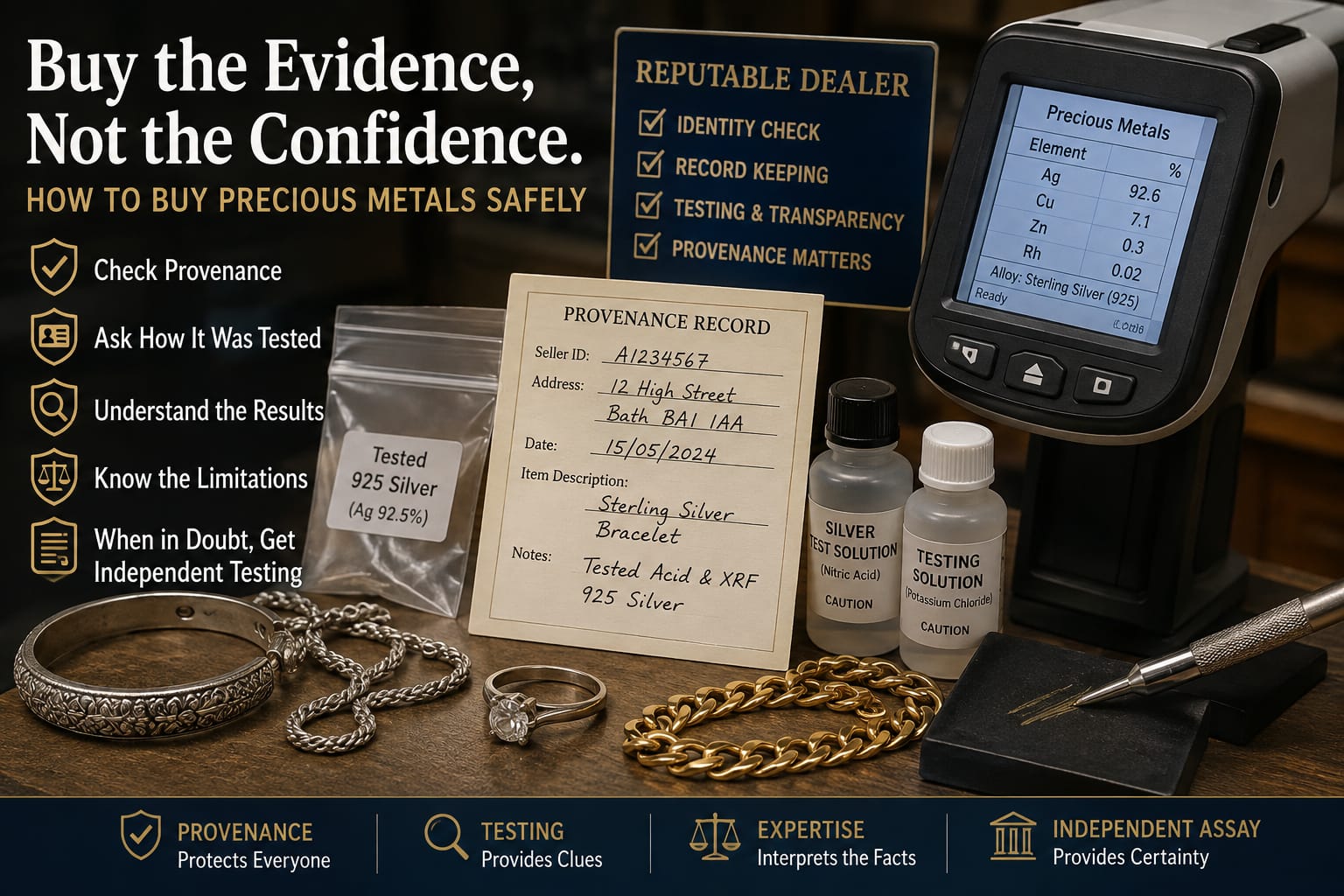
How to Buy Precious Metals Safely: Buy the Evidence, Not the Confidence
Buying precious metals online can be enormous fun.
You may discover antique silver, forgotten makers, unusual gemstones, broken gold and vintage jewellery for considerably less than you would expect to pay through a traditional jeweller.
Occasionally, you may even find something extraordinary.
However, there is another side to that opportunity:
You are accepting risk.
A live auction, online marketplace, boot sale, antiques fair and established bricks-and-mortar jeweller may offer very different levels of verification.
That does not automatically make one honest and another dishonest. Instead, it means you need to understand what you are buying, what evidence supports the description and how much certainty the seller is actually offering.
The same principle applies when you sell jewellery or precious metals.
So how do you buy precious metals safely and identify a dealer you are comfortable doing business with?
There is no single magic test, but there are several useful signs.
Start With Jewellery Provenance
One of the most important concepts in second-hand jewellery is provenance.
In simple terms, provenance means understanding where an object came from and maintaining a reasonable record of how it entered a dealer’s possession.
This matters because precious metals are portable, valuable and unfortunately attractive to thieves.
For that reason, a careful business buying jewellery from members of the public should take reasonable steps appropriate to the transaction to understand who is selling the property and where it came from.
Many professional precious-metal buyers ask for photographic identification. Some may also request proof of address or retain additional transaction records.
These checks are not a universal legal requirement for every ordinary jewellery purchase.
Nevertheless, formal customer-due-diligence obligations do apply in certain circumstances, particularly where businesses and transactions fall within anti-money-laundering rules.
Even when the law does not specifically require those checks, recording identity and provenance can still represent sensible best practice.
A dealer who routinely buys valuable second-hand gold and silver anonymously, asks no meaningful questions and keeps little information about where it came from has not automatically done anything unlawful.
However, that behaviour is a risk factor worth considering.
Look at How a Precious-Metal Dealer Buys
If a dealer buys jewellery directly from the public, their buying-in procedure can tell you a great deal about the way the business operates.
Ask yourself:
Do they want to know who owns the jewellery?
Do they record what they purchase?
Are sellers given paperwork?
Are items weighed properly?
Can the dealer explain how the precious-metal content is established?
Do they make reasonable enquiries when something about a transaction appears unusual?
A careful buying procedure cannot guarantee that every object will later be identified correctly.
However, it does tell you something about how seriously the dealer treats provenance, record keeping and accountability.
Ask How the Jewellery Was Tested
When precious-metal content affects what you are paying, asking about testing is completely reasonable.
A responsible seller should be able to explain exactly what they know.
For example:
“It is fully UK hallmarked.”
“It is stamped 925, but it has not been independently verified.”
“I acid-tested this area and obtained this reaction.”
“I took XRF readings from these locations.”
“I cannot confidently establish the metal, so I am selling it as costume jewellery.”
Statements like these are useful because they distinguish evidence from conclusion.
Where practical, a seller offering an individually tested item should also be willing to explain how that testing was performed.
If somebody refuses to explain the basis for an important claim about an expensive precious-metal item, you are perfectly entitled to walk away.
You never have to buy it.
Never Outsource All of Your Judgement to the Seller
This principle applies regardless of who you are buying from.
Small resellers can make mistakes.
Experienced dealers can make mistakes.
Hobbyists can make mistakes.
We can make mistakes too.
Anybody can say they have been testing silver for twenty years.
Acid-testing kits are readily available, while XRF analysers can be purchased by anybody with sufficient funds.
Owning testing equipment and knowing how to obtain, interpret and challenge a result are two very different things.
For that reason, never outsource all of your judgement to the seller.
If precious-metal content materially affects the value of what you have purchased, consider independent verification.
Likewise, if your own test produces a different result from the seller’s test, do not immediately move from:
“I got a different result”
to:
“The seller lied.”
Instead, establish why the two results disagree.
Different Test Results Do Not Automatically Mean Dishonesty
Precious-metal testing is not always straightforward.
Were the same parts of the object tested?
Was the jewellery plated?
Did both testers use the same reagent?
Was representative underlying metal actually exposed?
Was the XRF instrument suitable for the task?
Had the analyser been maintained and calibrated appropriately?
Could solder, clasps, fittings or different metals be present in different areas?
If the discrepancy genuinely matters, an experienced independent professional or an Assay Office is a much better next step than two informal testers arguing about whose result must be correct.
Independent verification protects both buyer and seller.
Do Not Confuse Testing Equipment With Expertise
This becomes especially important with plated jewellery.
Consider a rhodium-plated sterling-silver ring.
The outer surface is rhodium. The sterling silver sits underneath it.
If a direct surface test or touchstone sample does not adequately reach representative underlying metal, the coating may influence the result.
That does not automatically prove the object is not silver.
Instead, it tells you that the sampling method needs to be considered.
To draw conclusions about the underlying substrate, the test needs to examine material that actually represents that substrate.
Rhodium Plating Can Affect XRF Testing
XRF is enormously useful, but it is not a magic truth machine.
A plated object is a layered system.
For example, you may have:
Rhodium
over
Sterling silver.
Several factors can influence an XRF result, including the plating material, coating thickness, underlying metal, instrument, analytical programme, calibration and measurement location.
Professional XRF analysis therefore involves considerably more than pointing an analyser at an object and reading the numbers displayed on the screen.
The instrument must be suitable for the job and maintained correctly.
Just as importantly, the operator needs to understand what the result means and what it does not mean.
Anyone can own equipment. Expertise is knowing its limitations.
Silver Acid Testing Also Requires Interpretation
Acid testing has limitations too.
Different proprietary silver-testing reagents can use different chemistry and colour charts.
Therefore, learning one colour reaction and applying that interpretation to every silver test is unsafe.
Lower-fineness silver also contains a larger proportion of alloying metals than sterling silver.
With some traditional silver-testing reagents, lower-fineness silver can produce brownish or greenish reactions instead of the red reactions commonly associated with higher-fineness silver.
For that reason:
“It turned green, therefore there is no silver”
is not a reliable universal conclusion.
Better questions include:
Which reagent was used?
What does the manufacturer’s chart say?
What material was sampled?
Was plating present?
What other evidence does the object provide?
Age, Origin and Construction Matter
Modern British sterling silver represents only one part of the history of silverworking.
Antique and foreign pieces may have been produced at different finenesses, under different national standards and with completely different marking conventions.
Consequently, an old salt cellar, spoon, trinket box or piece of jewellery may require considerably more investigation than:
“It doesn’t say 925.”
Likewise, a numerical stamp or manufacturer’s mark is not automatically equivalent to an independent UK hallmark.
Research the marks.
Consider the period.
Investigate the maker.
Examine the construction.
Then interpret the testing alongside everything else you know.
What If the Marks and Test Results Disagree?
This is where a careful seller becomes particularly valuable.
Imagine an older object carries markings suggesting silver, but testing produces an unexpected result.
The responsible conclusion may not be:
“Definitely fake.”
Nor must it automatically be:
“Definitely silver.”
A more accurate description might be:
“The item is marked this way, but this is the test result I obtained. I cannot reconcile those pieces of evidence with certainty.”
That statement still gives the buyer useful information.
From there, the buyer can decide whether to accept the uncertainty, investigate further or obtain professional analysis.
There is nothing dishonest about uncertainty when it is disclosed clearly.
Know the Difference Between a Bargain and a Guarantee
This is particularly important when buying through online marketplaces and live-auction platforms.
Whatnot, eBay and similar platforms can produce fantastic finds.
However, some forms of online second-hand buying are better compared with an enormous digital antiques market or boot sale than with walking into a specialist jeweller.
You might find something exceptional.
An extraordinary bargain may appear.
Equally, an item might later require considerably more research than anybody realised when it was sold.
Part of bargain hunting is recognising that a lower price can sometimes come with less certainty.
If you require laboratory-level confidence about composition, origin or value, buy from somebody offering that level of verification or obtain it independently.
Price Should Reflect Certainty
A fully researched and independently verified object is a different proposition from an unidentified vintage item discovered in a mixed auction lot.
The level of certainty being offered should therefore form part of your buying decision.
For example, suppose a seller says:
“It is stamped 925, but I have not tested it.”
You should value that item with the uncertainty in mind.
By contrast:
“This has been independently assayed and here is the documentation.”
represents a very different level of evidence.
A seller should not charge you for certainty that has not actually been established.
When the Answer Matters, Get Independent Testing
If knowing the answer genuinely matters, stop guessing.
The UK’s Assay Offices exist because precious-metal identification and verification are specialist disciplines.
Professional analytical services can help investigate precious-metal composition, unusual objects and hallmarks.
Whether that expense is worthwhile depends entirely on the item.
Few people would commission extensive professional analysis on every inexpensive charm in a mixed jewellery box.
However, independent testing can make considerably more sense for an important antique, expensive piece, disputed item or object whose metal content could significantly affect its value.
The real question is:
How much is certainty worth in this particular case?
Red Flags When Buying Precious Metals
No single behaviour proves that a seller is dishonest.
Several warning signs appearing together should, however, encourage caution.
Be wary when a seller cannot explain where significant second-hand stock comes from, shows no meaningful interest in provenance, refuses to discuss testing methods, cannot explain contradictory results or treats every ambiguous result as an absolute conclusion.
Also be cautious of anyone who behaves as though one magnet, one acid reaction or one XRF reading can answer every possible question about every precious-metal object.
Expertise usually produces more nuance, not less.
Green Flags When Choosing a Jewellery Seller
Good sellers are usually comfortable admitting what they do not know.
They distinguish fineness stamps from hallmarks.
Testing methods are explained rather than hidden.
Sensible records are kept about where valuable second-hand stock came from.
Unusual pieces are researched instead of being forced into familiar categories.
Mistakes are corrected when better evidence becomes available.
When something exceeds their expertise, responsible sellers also know when to recommend independent professional testing.
No dealer will be perfect.
Anyone handling enough antique, vintage and second-hand jewellery will eventually encounter something unexpected.
The more revealing question is:
What do they do when the evidence becomes complicated?
Buy the Evidence, Not the Confidence
Confidence is remarkably cheap.
Speaking forcefully does not make somebody scientifically correct.
A careful seller should be able to explain what they tested, where they tested it, which method they used, what result they obtained and how much certainty that result actually supports.
Sometimes the available evidence supports nothing more than:
“It is stamped silver, but my test produced an unusual result.”
If that is what the evidence shows, that may be exactly what the seller should say.
The buyer can then make an informed decision.
The Alex Ruby Rule: Transparency Before Certainty
At Alex Ruby, our preferred principle is simple:
Tell people what you know.
Explain how you know it.
Be equally clear about what you don’t know.
Never outsource all of your judgement to the seller.
And above all:
Buy the evidence, not the confidence.
An item’s marks provide evidence.
Provenance provides evidence.
Acid testing provides evidence.
XRF readings provide evidence.
Age and construction provide additional context.
Independent professional analysis can provide stronger evidence again.
Good precious-metal dealing means assembling those pieces rather than stretching one observation beyond what it can actually prove.
Likewise, good buying means understanding exactly how much risk you are accepting.
Sometimes you are buying certainty.
At other times, you are buying expertise.
Occasionally, you are buying a £5 mystery from what is effectively a digital boot sale and hoping you have spotted something wonderful.
All three can be perfectly legitimate ways to buy jewellery.
You simply need to know which one you are doing.
This article provides general educational information about buying and selling second-hand jewellery and precious metals in the UK. Identification, record-keeping, hallmarking and anti-money-laundering obligations depend on the circumstances of the business and transaction. It is not legal advice. Where precious-metal composition, provenance or value is important, appropriate professional advice or independent assay should be considered.